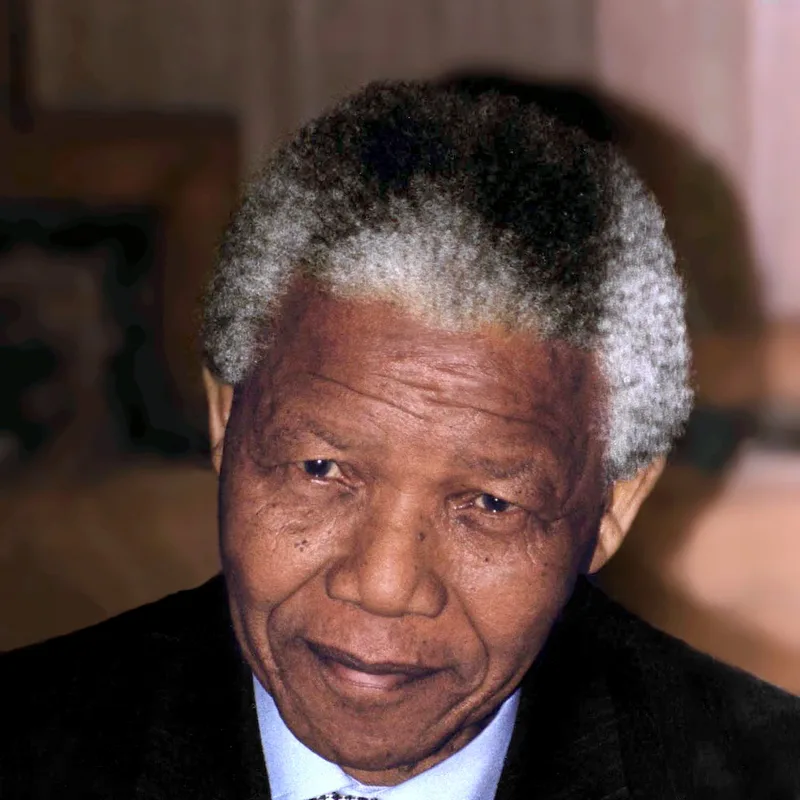
Nelson Mandela
President of South Africa, Anti-apartheid activist, 1918–2013
Methodist
What is the meaning of life?
To make a difference to the lives of others.
Mandela answered in terms of duty and of other people. At the Rivonia trial in April 1964, facing a possible death sentence, he told the court that he had dedicated his life to the struggle of the African people, against white and against black domination, for a free society he hoped to live for and was prepared to die for. He was sentenced to life imprisonment and served twenty-seven years in prison before his release in 1990. In 2002, at the ninetieth birthday of his old comrade Walter Sisulu, he repeated what he often told younger people: what counts in life is not the mere fact that we have lived but the difference we have made to the lives of others.
-
“During my lifetime I have dedicated myself to this struggle of the African people. I have fought against white domination, and I have fought against black domination. I have cherished the ideal of a democratic and free society in which all persons live together in harmony and with equal opportunities. It is an ideal which I hope to live for and to achieve. But if needs be, it is an ideal for which I am prepared to die.”1
-
“Often in addressing younger people I make the point that what counts in life is not the mere fact that we have lived. It is what difference we have made to the lives of others that will determine the significance of the life we lead.”2
What is the meaning of the universe?
A Creator whose children we all are; death, a rest after duty.
Mandela was baptised a Methodist and educated at Methodist mission schools, Clarkebury and Healdtown, and in 1998 he told the church's conference that the values he was taught there had served him well throughout his life. He seldom spoke about his personal faith; his biographer Anthony Sampson judged that he never had a strong religious faith, while the Methodist Church held that he kept his allegiance to it. In public he spoke of God as Creator: at a Zion Christian Church Easter gathering in 1992 he called all people, of every colour, the Creator's children, and in 1999 he told the Parliament of the World's Religions that religious people had given prisoners hope under apartheid. Of death he said, in an interview for a documentary, that a man who has done what he considers his duty to his people and his country can rest in peace.
-
“We affirm it and we shall proclaim it from the mountaintops, that all people – be they black or white, be they brown or yellow, be they rich or poor, be they wise or fools, are created in the image of the Creator and are his children!”3
-
“But I must also add that I do appreciate the importance of religion. Apart from the background that I've given you, you'd have to have been in a South African jail under apartheid where you can see the cruelty of human beings to others in their naked form. But it was again religious institutions, Hindus, Moslems, leaders of the Jewish faith, Christians, it was them who gave us the hope that one day we would come out.”4
-
“Death is something inevitable. When a man has done what he considers to be his duty to his people and his country, he can rest in peace. I believe I have made that effort and that is, therefore, why I will sleep for the eternity.”5