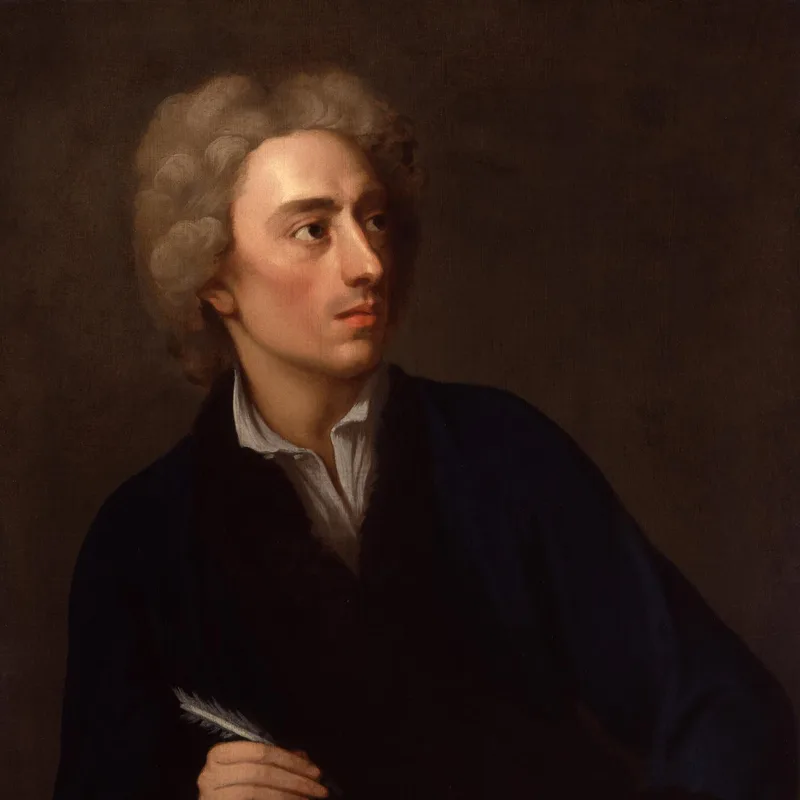
Alexander Pope
Poet, Satirist, 1688–1744
Catholic, cosmic optimist
What is the meaning of life?
Happiness is our aim, and virtue alone is happiness below.
Pope was a Catholic in an England that barred Catholics from the universities, from public office and from living within ten miles of London, and a lifelong invalid, stunted by tuberculosis of the spine, who became the leading poet of his age and one of the first English writers to live on his pen. An Essay on Man (1733–34), addressed to his friend Lord Bolingbroke, sets out in rhyming couplets to vindicate the ways of God to man. Its fourth epistle is about happiness: the end and aim of our being, sought by everyone in different places, and found, Pope concludes, not in wealth, fame or greatness but in virtue. Man's business, he wrote, is not to pry into God but to know himself.
-
“Oh, happiness, our being’s end and aim! / Good, pleasure, ease, content! whate’er thy name: / That something still which prompts the eternal sigh, / For which we bear to live, or dare to die…”1
-
“Know, then, this truth (enough for man to know) / “Virtue alone is happiness below.””1
-
“Know, then, thyself, presume not God to scan; / The proper study of mankind is man.”2
What is the meaning of the universe?
One stupendous whole, whose body Nature is, and God the soul.
Pope's universe is a vast, ordered chain of being, from God down through angels and men to the smallest insect, in which every creature has its fitting place. What looks to us like chance, discord or evil only looks that way because we see a part and not the whole; seen whole, he argued, whatever is, is right. Nature is the body of that whole and God its soul, present in the sun, the breeze and the stars as fully as in a human being. Some readers called the poem deist or even pantheist, which Pope denied, and after the Lisbon earthquake of 1755 Voltaire attacked its optimism.
-
“All are but parts of one stupendous whole, / Whose body Nature is, and God the soul; / That, changed through all, and yet in all the same; / Great in the earth, as in the ethereal frame; / Warms in the sun, refreshes in the breeze, / Glows in the stars, and blossoms in the trees…”3
-
“All nature is but art, unknown to thee; / All chance, direction, which thou canst not see; / All discord, harmony not understood; / All partial evil, universal good: / And, spite of pride in erring reason’s spite, / One truth is clear, whatever is, is right.”3