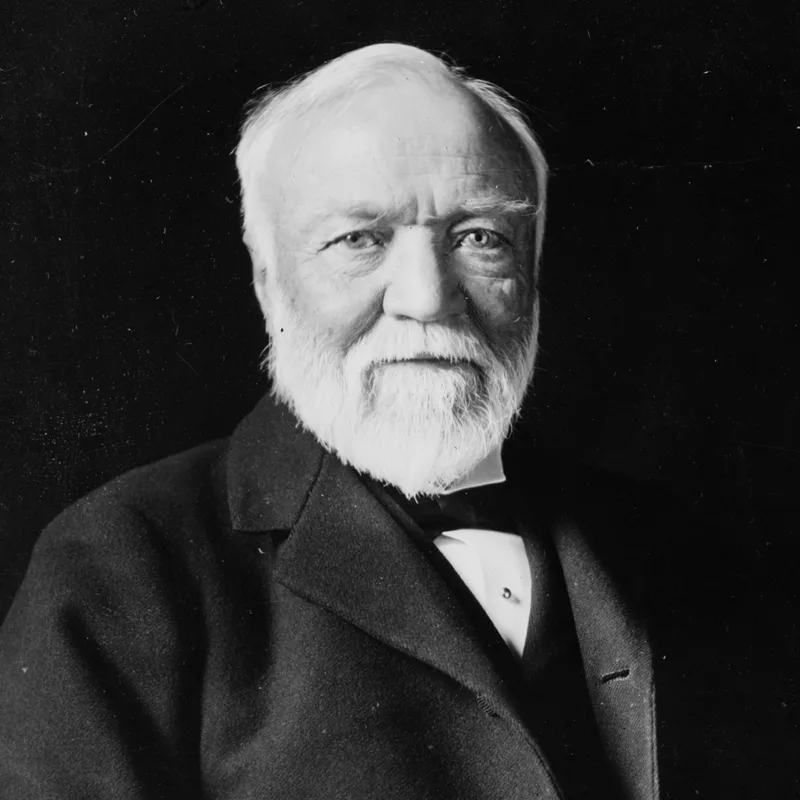
Andrew Carnegie
Industrialist, Philanthropist, 1835–1919
Evolutionist, no theology
What is the meaning of life?
Not to die rich: make a fortune, then give it away.
Carnegie came to the United States from Scotland as a poor boy, started work in a cotton mill at thirteen and built one of the largest steel companies of his time. As early as 1868, at 33, he wrote himself a memo warning that the worship of money was the most debasing kind of idolatry. In Wealth (1889), later known as The Gospel of Wealth, he argued that the rich hold their fortunes in trust for the community and should give them away while they live. He sold his company in 1901 and spent the rest of his life giving away most of his fortune, much of it to public libraries.
What is the meaning of the universe?
No theology, no supernatural: evolution, and all growing better.
As a young man Carnegie came to doubt the theology he had grown up with: the supernatural, and salvation through Christ's atonement. Reading Darwin and especially Herbert Spencer gave him something to put in its place: the universe as a process of evolution, moving from lower forms to higher with no conceivable end. He described the change as light coming in like a flood. He kept a reverence for the moral teaching of religion, but not its supernatural claims.
-
“Not only had I got rid of theology and the supernatural, but I had found the truth of evolution. “All is well since all grows better” became my motto, my true source of comfort.”3
-
“Man was not created with an instinct for his own degradation, but from the lower he had risen to the higher forms. Nor is there any conceivable end to his march to perfection.”3