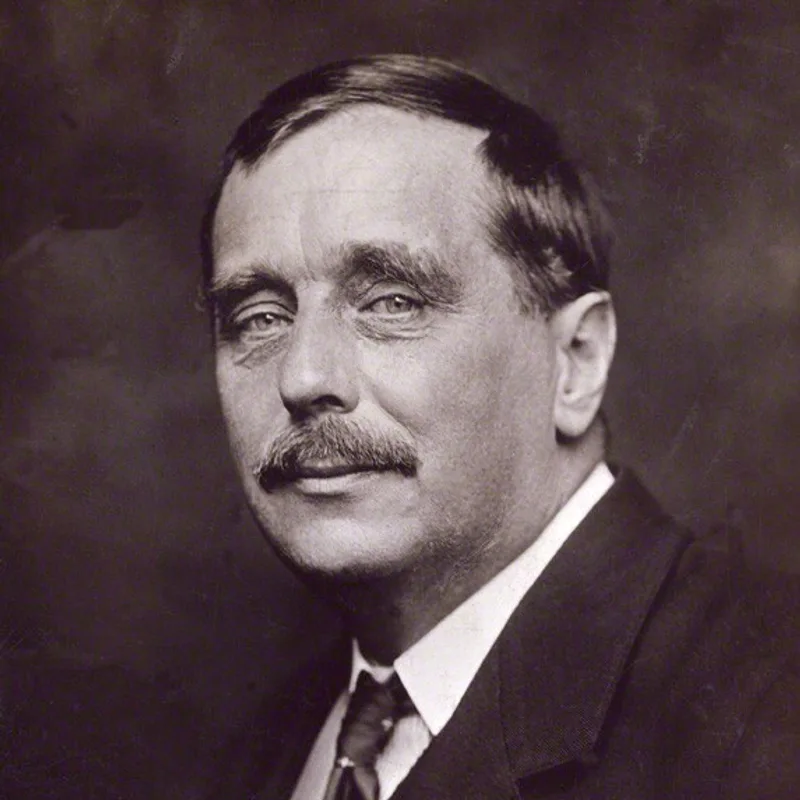
H. G. Wells
Novelist, Essayist, 1866–1946
Humanist with a mystic faith
What is the meaning of life?
To serve the growing life of the species, then pass away.
Wells grew up poor, the son of a shopkeeper and a lady's maid, worked as a draper's apprentice and won a scholarship to study biology under T. H. Huxley before writing The Time Machine, The War of the Worlds and dozens of other books. In First and Last Things (1908), subtitled “a confession of faith and rule of life”, he set out what he believed. The individual, he wrote, is an episode, a temporary enclosure for a temporary purpose; what lasts and matters is the slow unfolding of mankind's sense of community and common purpose. To see one's own part in that whole, and to act on it, was the meaning he found for his life.
-
“The essential fact in man’s history to my sense is the slow unfolding of a sense of community with his kind, of the possibilities of co-operations leading to scarce dreamt-of collective powers, of a synthesis of the species, of the development of a common general idea, a common general purpose out of a present confusion.”1
-
“It is because we are episodical in the great synthesis of life that we have to make the utmost of our individual lives and traits and possibilities.”2
What is the meaning of the universe?
One ordered universe where every part matters; no personal immortality.
Wells called his basic belief an act of faith: a deliberate choice to hold that the universe is one ordered scheme in which he and every other part, down to a frog crushed on the road, is important. He could not say what the scheme was and did not want to imply a Schemer; he avoided the word God because people would take it to mean a person, though in rare moments he felt a kind of communion with “something great that is not myself”. He did not believe in personal immortality. Later he swung both ways: in God the Invisible King (1917) he championed a finite God, a book he came to regret, and his last book, Mind at the End of Its Tether (1945), was deeply pessimistic about humanity's future.
-
“Now my most comprehensive belief about the external and the internal and myself is that they make one universe in which I and every part are ultimately important.”3
-
“What the scheme as a whole is I do not know; with my limited mind I cannot know. There I become a Mystic. I use the word scheme because it is the best word available, but I strain it in using it. I do not wish to imply a schemer, but only order and co-ordination as distinguished from haphazard.”3
-
“I do not believe I have any personal immortality. I am part of an immortality perhaps; but that is different. I am not the continuing thing. I personally am experimental, incidental.”4