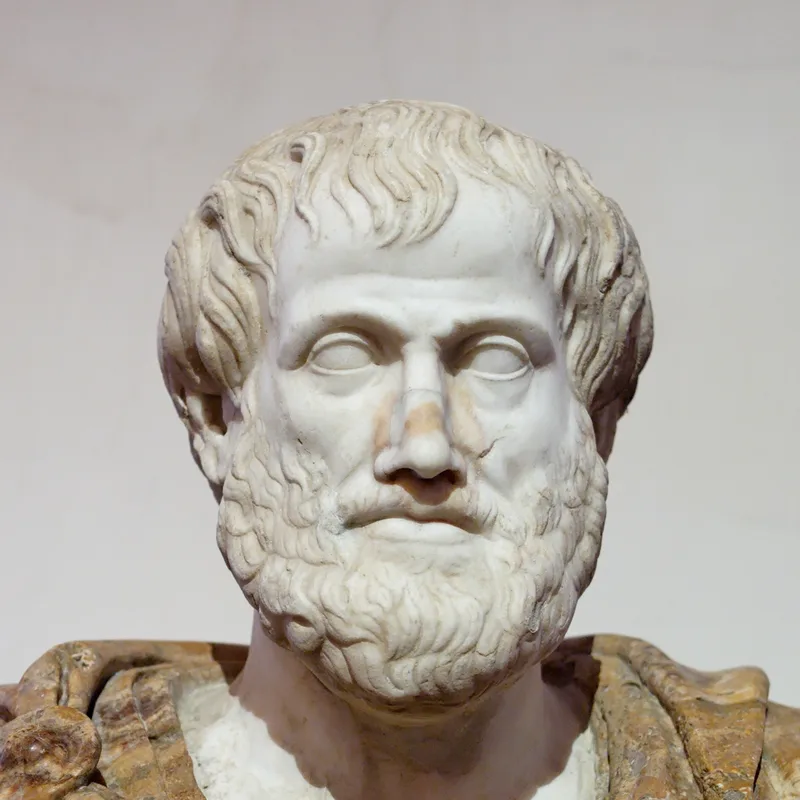
Aristotle
Philosopher, Natural scientist, 384–322 BC
Teleological theist
What is the meaning of life?
Eudaimonia: the soul active in virtue, over a complete life.
Aristotle's answer is in the Nicomachean Ethics, lecture notes from his school in Athens in the 330s and 320s BC. Every activity aims at some good, and the highest good — the one we want for its own sake and never for anything else — is eudaimonia, usually translated "happiness" but closer to flourishing or living well. He gets at it through the human function: what is peculiar to us is the activity of reason, so the human good is activity of the soul in accordance with virtue, kept up over a whole life and helped by enough external goods. In Book X he ranks the contemplative life highest, because it exercises the divine element in us; a life of practical virtue in the city is happy in a second way. Two lines often attributed to him, "We are what we repeatedly do" and "Happiness depends upon ourselves", are later glosses, not his sentences.
-
“Happiness, then, is something final and self-sufficient, and is the end of action.”1
-
“Human good turns out to be activity of soul in accordance with virtue, and if there are more than one virtue, in accordance with the best and most complete. But we must add "in a complete life." For one swallow does not make a summer, nor does one day; and so too one day, or a short time, does not make a man blessed and happy.”2
-
“The life of money-making is one undertaken under compulsion, and wealth is evidently not the good we are seeking; for it is merely useful and for the sake of something else.”3
-
“But we must not follow those who advise us, being men, to think of human things, and, being mortal, of mortal things, but must, so far as we can, make ourselves immortal, and strain every nerve to live in accordance with the best thing in us; for even if it be small in bulk, much more does it in power and worth surpass everything.”4
What is the meaning of the universe?
An eternal cosmos moved by an unmoved mover: thought thinking itself.
Aristotle's universe, set out in the Physics, On the Heavens and Metaphysics XII, is eternal in both directions and finite in size: a spherical earth at rest in the centre, surrounded by rotating spheres that carry the moon, sun, planets and stars. Since whatever moves is moved by something, and the chain cannot run back forever, there has to be a first mover that is not itself moved: pure actuality, without matter, eternal. It moves the outermost heaven not by pushing but the way an object of love moves a lover. This is his God, a living being whose life is thought thinking itself; it did not create the world and takes no interest in human affairs. The old stories of gods in human shape he treated as myth wrapped around one true idea, that the first substances are divine.
-
“There is, then, something which is always moved with an unceasing motion, which is motion in a circle; and this is plain not in theory only but in fact. Therefore the first heaven must be eternal. There is therefore also something which moves it. And since that which moves and is moved is intermediate, there is something which moves without being moved, being eternal, substance, and actuality.”5
-
“The final cause, then, produces motion as being loved, but all other things move by being moved. … On such a principle, then, depend the heavens and the world of nature.”6
-
“And life also belongs to God; for the actuality of thought is life, and God is that actuality; and God's self-dependent actuality is life most good and eternal. We say therefore that God is a living being, eternal, most good, so that life and duration continuous and eternal belong to God; for this is God.”6
-
“Therefore it must be of itself that the divine thought thinks (since it is the most excellent of things), and its thinking is a thinking on thinking.”7