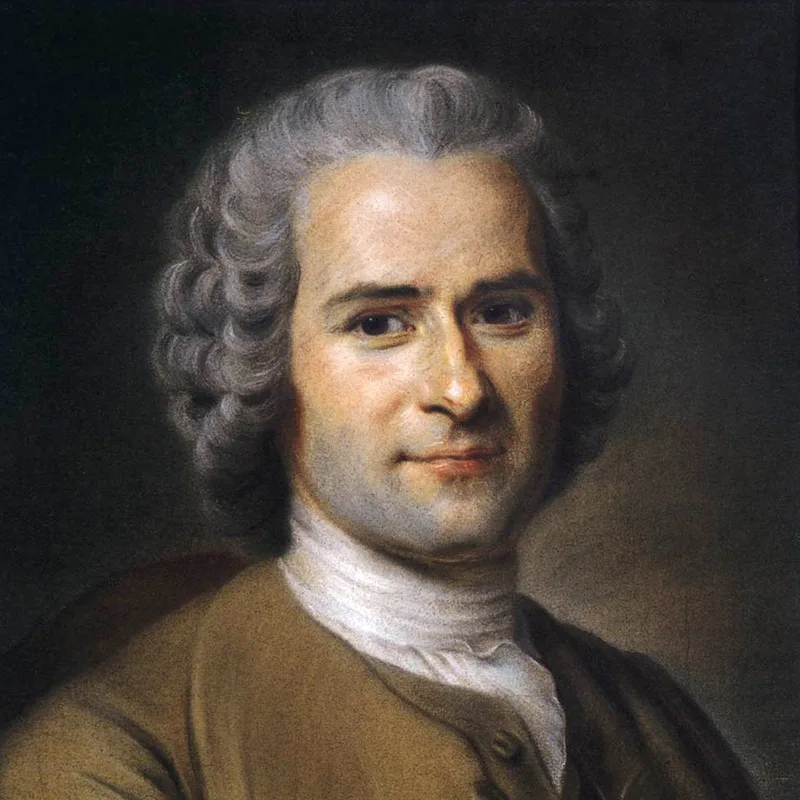
Jean-Jacques Rousseau
Philosopher, Writer, Composer, 1712–1778
Deist
What is the meaning of life?
Not to breathe longest but to feel life most, led by conscience.
Rousseau's Emile (1762), a treatise on education told as the story of a boy raised close to nature, puts the aim of life in living fully rather than long. Life is action, the use of our senses, minds and powers, and the person who has lived most is not the one who has counted the most years but the one who has felt life most. Civilized society, he argued throughout his work, makes people dependent, vain and unhappy; a good life follows nature and the feelings of the heart. Its guide is conscience, which he called a divine instinct and the voice of heaven in us.
-
“Teach him to live rather than to avoid death: life is not breath, but action, the use of our senses, our mind, our faculties, every part of ourselves which makes us conscious of our being. Life consists less in length of days than in the keen sense of living.”1
-
“Conscience! Conscience! Divine instinct, immortal voice from heaven; sure guide for a creature ignorant and finite indeed, yet intelligent and free; infallible judge of good and evil, making man like to God!”2
What is the meaning of the universe?
A wise and powerful will rules the world; I feel it.
Rousseau's religion is set out in the Creed of a Savoyard Priest, a long section of Emile in which a country priest explains his faith to a young man; Rousseau later defended it as his own. The order and motion of the world point to a will that is wise and powerful, which the priest knows by feeling and conscience rather than by doctrine, revelation or miracles. Beyond that, whether the world was created and what God's substance is, he declines to speculate. Both the Catholic authorities in Paris and Calvinist Geneva condemned the book, and Rousseau had to flee.
-
“I believe, therefore, that the world is governed by a wise and powerful will; I see it or rather I feel it, and it is a great thing to know this. But has this same world always existed, or has it been created? … I know not; and what concern is it of mine?”2
-
“I see God everywhere in his works; I feel him within myself; I behold him all around me; but if I try to ponder him himself, if I try to find out where he is, what he is, what is his substance, he escapes me and my troubled spirit finds nothing.”2