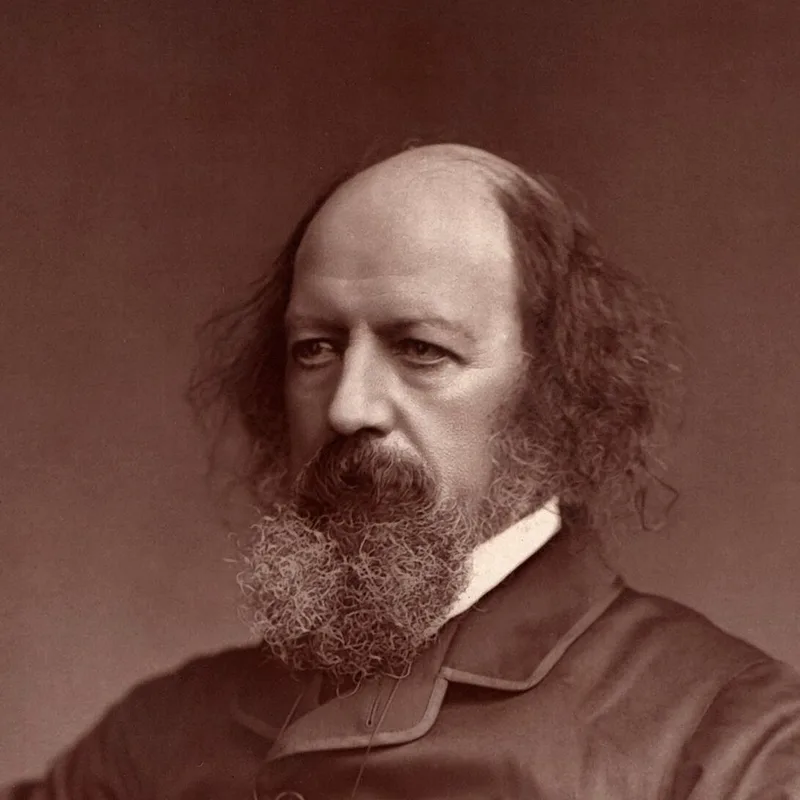
Alfred, Lord Tennyson
Poet, Poet Laureate, 1809–1892
Christian, wrestling with doubt
What is the meaning of life?
To love, even if we lose; to strive and not yield.
Tennyson was the most popular English poet of the Victorian age and Poet Laureate for more than forty years. The great event of his life was the sudden death in 1833 of his closest friend, Arthur Hallam, at twenty-two; he spent seventeen years writing the elegies that became In Memoriam A.H.H. (1850). Out of that grief came the conviction that love is worth its loss: it is better to have loved and lost than never to have loved at all. Soon after Hallam's death he also wrote “Ulysses”, about the old king setting out on one last voyage; he later said there was more of himself in that poem than in many in In Memoriam, written with the feeling that life must still be fought out to the end.
-
“I hold it true, whate'er befall; / I feel it, when I sorrow most; / 'Tis better to have loved and lost / Than never to have loved at all.”1
-
“Though much is taken, much abides; and though / We are not now that strength which in old days / Moved earth and heaven, that which we are, we are — / One equal temper of heroic hearts, / Made weak by time and fate, but strong in will / To strive, to seek, to find, and not to yield.”2
What is the meaning of the universe?
Through doubt, a trust that good is the final goal of ill.
In Memoriam is a long argument with doubt. Tennyson had read the geology of his day, with its vanished species and its indifferent ages of time, and he could not unsee a Nature “red in tooth and claw” that seemed to care nothing for the individual or even for the species. Against that he set a trust he could not prove: that somehow good will be the final goal of ill, and that nothing walks with aimless feet. He honoured honest doubt above easy creeds, and ended the poem with faith in one God, one law, and one far-off divine event to which the whole creation moves.
-
“O, yet we trust that somehow good / Will be the final goal of ill, / To pangs of nature, sins of will, / Defects of doubt, and taints of blood; / That nothing walks with aimless feet; / That not one life shall be destroyed, / Or cast as rubbish to the void, / When God hath made the pile complete.”3
-
“Perplext in faith, but pure in deeds, / At last he beat his music out. / There lives more faith in honest doubt, / Believe me, than in half the creeds.”4
-
“That God, which ever lives and loves, / One God, one law, one element, / And one far-off divine event, / To which the whole creation moves.”5