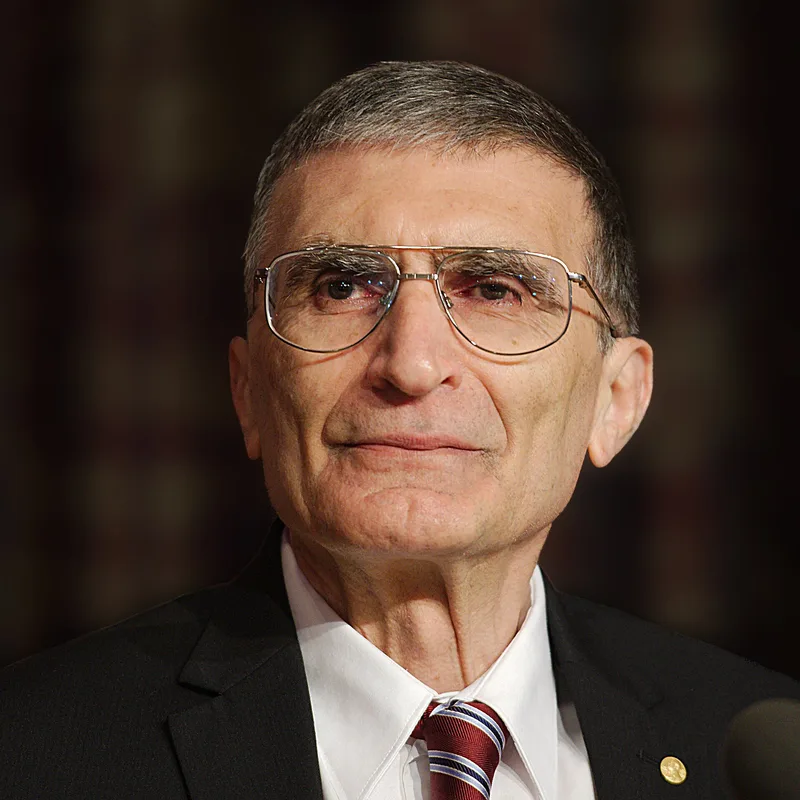
Aziz Sancar
Biochemist, Nobel laureate, born 1946
Muslim; science and faith apart
What is the meaning of life?
We came here to leave something good behind.
Sancar was born in 1946 in Savur, a small town in Mardin, the seventh of eight children, and trained as a doctor at Istanbul University before turning to research in the United States. At the University of North Carolina he worked out how cells repair damaged DNA, work that won him the 2015 Nobel Prize in Chemistry, shared with Tomas Lindahl and Paul Modrich; he later gave his Nobel medal to Anıtkabir, Atatürk's mausoleum. Asked in 2022 what kept him working so hard at 75, he urged his compatriots to stop quarrelling and criticising one another, and said that we come into this world to leave something good behind. Contributing to Turkey, to the Turkic world and to humanity, he said, is what makes him happy.
-
“We have come into this world; we will leave something good behind and move on. That is what I think.”1
What is the meaning of the universe?
A believing Muslim who keeps religion out of the lab.
Sancar calls himself a Muslim, and he sees no conflict with his science because he keeps the two apart. An answer he once gave to a student in Azerbaijan was reported as a rejection of evolution; he later said he had answered in haste, tired after a long day, and had been quoted only in part. Explaining himself in 2018, he said that scientific questions are not to be settled by religious belief: in the lab he may say 'God willing, this experiment will work', but he does not ask God to make it work. Science, for him, is about this world, and this world can be understood by scientific thought and scientific method.
-
“Look, I am a Muslim, and at the same time I do molecular biology and biochemistry; in this research I do not think about religion.”2