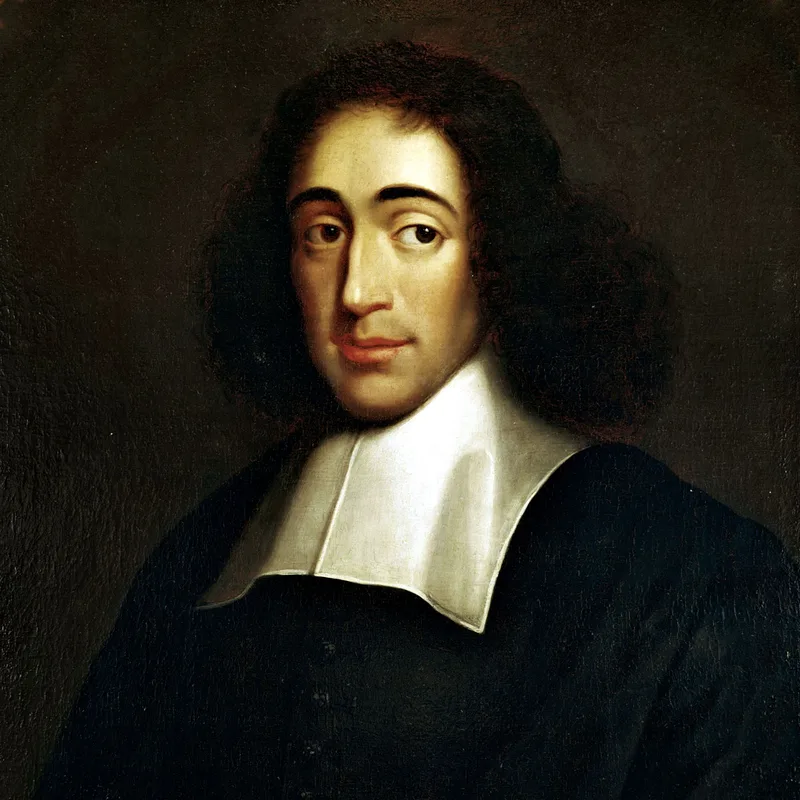
Baruch Spinoza
Philosopher, Lens grinder, 1632–1677
Pantheist
What is the meaning of life?
To understand God-or-Nature and love it; blessedness is virtue itself.
Spinoza was expelled from Amsterdam's Portuguese-Jewish community at 23, ground lenses for a living and wrote the Ethics in the form of geometry, with definitions, axioms and proofs; it appeared only after his death in 1677. He had begun, in the unfinished Treatise on the Emendation of the Intellect, by setting aside riches, fame and pleasure as goods that cannot last, and asking whether there was something whose discovery would give lasting joy. The Ethics answers that the highest good of the mind is knowledge of God, which for him means Nature, and that from understanding things adequately grows an intellectual love of God that nothing can take away. Blessedness is not a reward for virtue but virtue itself. A free man, led by reason rather than fear, thinks about life, not death.
-
“After experience had taught me that all the usual surroundings of social life are vain and futile … I finally resolved to inquire whether there might be some real good having power to communicate itself, which would affect the mind singly, to the exclusion of all else: whether, in fact, there might be anything of which the discovery and attainment would enable me to enjoy continuous, supreme, and unending happiness.”1
-
“The mind's highest good is the knowledge of God, and the mind's highest virtue is to know God.”2
-
“A free man thinks of death least of all things; and his wisdom is a meditation not of death but of life.”3
-
“Blessedness is not the reward of virtue, but virtue itself; neither do we rejoice therein, because we control our lusts, but, contrariwise, because we rejoice therein, we are able to control our lusts.”4
What is the meaning of the universe?
One infinite substance, God or Nature; everything follows from it necessarily.
In Part I of the Ethics Spinoza argues that there can be only one substance, infinite and the cause of itself, which he calls God; thought and extension are two of its infinitely many attributes, and everything that exists, minds and bodies included, is a mode of it. God is therefore not a maker standing outside the world but its indwelling cause: Deus sive Natura, God or Nature. Nothing in nature happens for a purpose; final causes are human fictions, and everything follows from God's nature with the necessity by which a triangle's angles add up to two right angles. This God does not love or judge anyone and answers no prayers, which is why contemporaries called Spinoza an atheist and why Einstein later said he believed in "Spinoza's God".
-
“Whatsoever is, is in God, and without God nothing can be, or be conceived.”5
-
“God is the indwelling and not the transient cause of all things.”6
-
“There is no need to show at length, that nature has no particular goal in view, and that final causes are mere human figments.”7
-
“For the eternal and infinite Being, which we call God or Nature, acts by the same necessity as that whereby it exists.”8