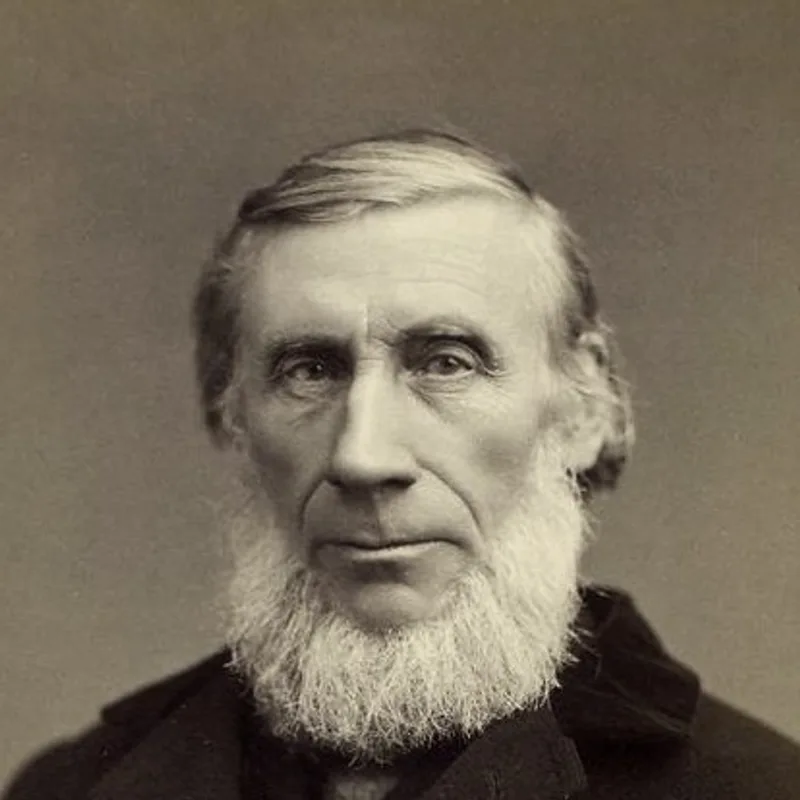
John Tyndall
Physicist, Mountaineer, 1820–1893
Scientific naturalist
What is the meaning of life?
Brighten the life that now is, not a life to come.
Tyndall grew up in a modest family in County Carlow, Ireland, worked as a surveyor and railway engineer, and took a doctorate in Germany before becoming Michael Faraday's colleague and then his successor at the Royal Institution in London. He showed that gases such as water vapour and carbon dioxide absorb heat radiation, a foundation of our understanding of the greenhouse effect, studied why the sky is blue, and was a celebrated public lecturer and a pioneering Alpine climber. He hoped that religion would come to purify and brighten the life we have now, instead of treating it as a waiting room for a life to come. Living things, he wrote, are like waves: patterns that persist while the particles in them are always being replaced.
-
“[O]f the future form of religion little can be predicted. Its main concern may possibly be to purify, elevate, and brighten the life that now is, instead of treating it as the more or less dismal vestibule of a life that is to come.”1
-
“Life is a wave, which in no two consecutive moments of its existence is composed of the same particles.”2
What is the meaning of the universe?
Science claims the cosmos, but the mind's range ends in silence.
As president of the British Association, Tyndall gave the Belfast Address of 1874, claiming for science the whole field of cosmological theory and tracing all life back to the potency of matter; churchmen denounced him as a materialist. A close friend of Thomas Huxley, he was an agnostic who never claimed to know what lay behind nature. The human mind, he wrote, is like an instrument with a limited range of notes, beyond which lies an infinite silence; and religious feeling, which he counted as real as any other part of human consciousness, is something the waves of science beat against in vain.
-
“The mind of man may be compared to a musical instrument with a certain range of notes, beyond which in both directions we have an infinitude of silence.”3
-
“Religious feeling is as much a verity as any other part of human consciousness; and against it, on the subjective side, the waves of science beat in vain.”4