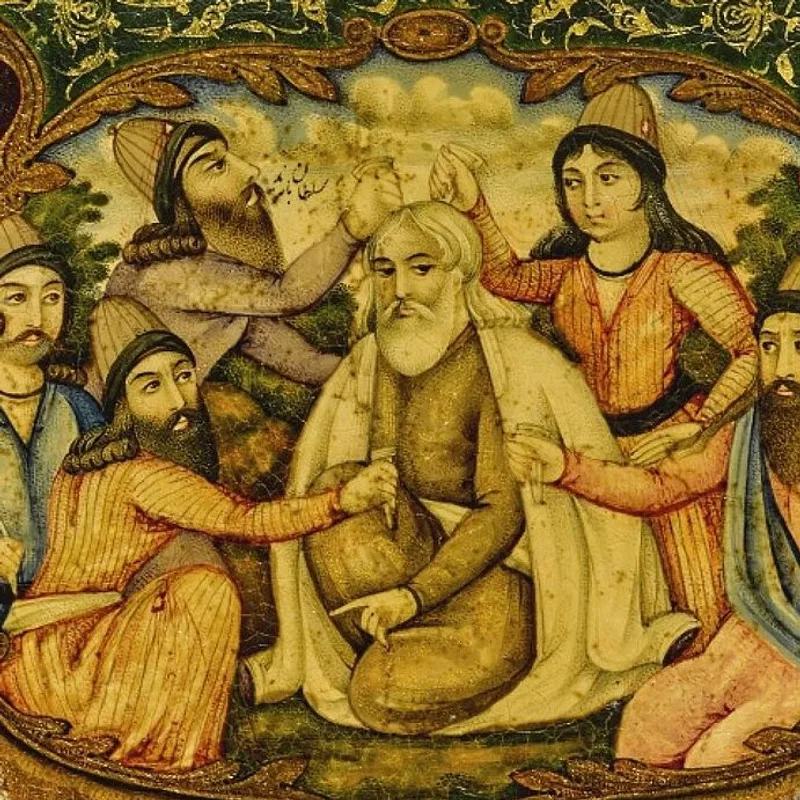
Bayazid Bastami
Sufi mystic, 804–874
Ecstatic Sufi
What is the meaning of life?
Be generous as the sea, kind as the sun, humble as earth.
Bayazid, or Abu Yazid, of Bistam in northern Persia spent most of his life in his home town, practising decades of austerity, and became one of the founding figures of “intoxicated” Sufism, known for ecstatic utterances in which the self seems to dissolve into God. He left no books; his sayings were collected by his followers and, centuries later, by the poet Attar. The signs of one whom God loves, he said, are three: generosity like the sea, kindness like the sun, and humility like the earth, which lets itself be trodden on by everyone.
-
“He whom the Lord loves is known by three distinct signs—his liberality is like the sea, his kindness is like the sun, his humility is like the earth, which allows itself to be trampled on by everyone.”1
What is the meaning of the universe?
God's treasury is full of worship; bring Him a humble, contrite heart.
Bayazid's God is the one reality before which the self must vanish, and his most daring sayings, such as “Glory be to me, how great is my majesty!”, were understood by his admirers as God speaking through a man who had passed away from himself. Beside the ecstasy there is humility. In one of the stories Attar tells, Bayazid hears a voice telling him that God's treasure-house is already full of acts of worship offered by men; what He wants is something not in His treasury: sorrow of heart, humility, contrition.
-
“One day I heard a Voice, which said, 'O Bayazid, our treasure-house is brimmed full with acts of adoration and devotion offered by men; bring Us something which is not in Our treasury.' 'But, O God,' I cried, 'what then shall I bring?' And the voice answered me, 'Bring Me sorrow of heart, humility, contrition.'”1