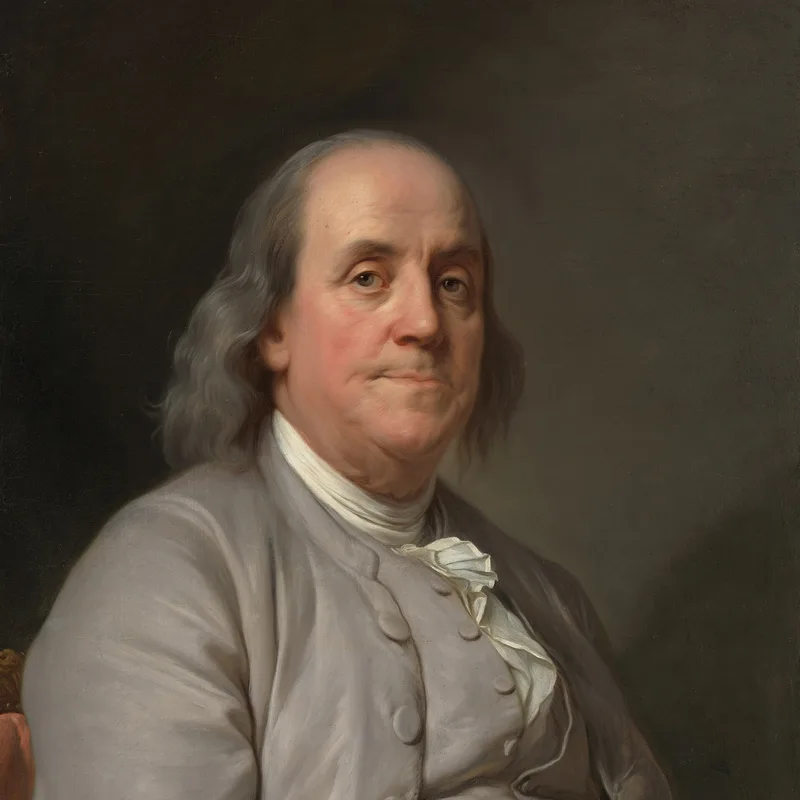
Benjamin Franklin
Writer and printer, Scientist, Statesman, 1706–1790
Deist
What is the meaning of life?
Doing good to others — the most acceptable service to God.
Franklin's answer was practical and moral. As a young man he conceived what he called the bold and arduous project of arriving at moral perfection through thirteen virtues, and in his Articles of Belief (1728) he reasoned that since there is no happiness without virtue, God must delight to see us virtuous. Serving others was, for him, not charity but repayment: in a 1753 letter he wrote that he could only return the kindness he had received by helping his fellow men, and that a faith which rests in hearing sermons and praying is like a tree proud of its leaves that bears no fruit. Doing good, he told Ezra Stiles at the end of his life, is the most acceptable service we render to God.
-
“For my own Part, when I am employed in serving others, I do not look upon myself as conferring Favours, but as paying Debts. In my Travels, and since my Settlement, I have received much Kindness from Men, to whom I shall never have any Opportunity of making the least direct Return. … Those Kindnesses from Men, I can therefore only Return on their Fellow Men; and I can only shew my Gratitude for these mercies from God, by a readiness to help his other Children and my Brethren.”1
-
“It was about this time I conceived the bold and arduous project of arriving at moral perfection. I wish'd to live without committing any fault at any time; I would conquer all that either natural inclination, custom, or company might lead me into.”2
-
“I believe there is one Supreme most perfect being. … I believe He is pleased and delights in the happiness of those He has created; and since without virtue man can have no happiness in this world, I firmly believe He delights to see me virtuous.”3
What is the meaning of the universe?
One Creator who governs by Providence; the soul is immortal.
Brought up piously in Boston in the Dissenting way, Franklin began doubting revelation itself at fifteen; books written against deism made the deists' arguments look stronger to him, and he became, in his words, a thorough Deist. He later suspected the doctrine, though it might be true, was not very useful, and he never doubted that God made the world and governs it by his Providence. In a letter to Ezra Stiles, five weeks before he died in 1790, he set out his creed — one God, creator of the universe, an immortal soul treated with justice in another life — and said he had doubts about the divinity of Jesus but did not dogmatize, since he expected soon to know the truth with less trouble. At twenty-two he had written his own epitaph: the body as the cover of an old book, the work to appear again in a new and more perfect edition.
-
“I believe in one God, creator of the universe. That he governs it by his Providence. That he ought to be worshiped. That the most acceptable service we render to him is doing good to his other children. That the soul of man is immortal, and will be treated with justice in another life respecting its conduct in this.”4
-
“As to Jesus of Nazareth, … I think the system of morals, and his religion, as he left them to us, the best the world ever saw, or is likely to see; but I apprehend it has received various corrupting changes, and I have, with most of the present dissenters in England some doubts as to his divinity; tho' it is a question I do not dogmatize upon, having never studied it, and think it needless to busy myself with it now, when I expect soon an opportunity of knowing the truth with less trouble.”4
-
“Some books against Deism fell into my hands; they were said to be the substance of sermons preached at Boyle's Lectures. It happened that they wrought an effect on me quite contrary to what was intended by them; for the arguments of the Deists, which were quoted to be refuted, appeared to me much stronger than the refutations; in short, I soon became a thorough Deist.”5
-
“The Body of B. Franklin Printer; Like the Cover of an old Book, Its Contents torn out, And stript of its Lettering and Gilding, Lies here, Food for Worms. But the Work shall not be wholly lost: For it will, as he believ'd, appear once more, In a new & more perfect Edition, Corrected and Amended By the Author.”6