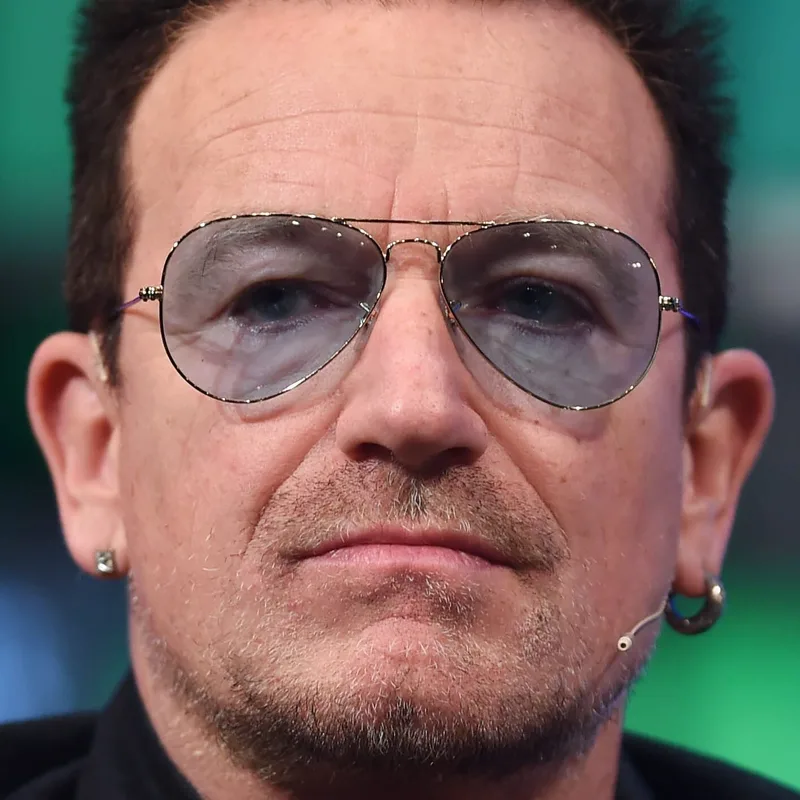
Bono
Singer-songwriter, Activist, born 1960
Non-denominational Christian
What is the meaning of life?
To act on love, and join God's work among the poor.
Bono puts his answer in religious terms but measures it in action. In conversations with the French journalist Michka Assayas, published in 2005, he said his religion was simple: God is love, and his part is to let that love transform him and to act in it — the hard part is living it. At the National Prayer Breakfast in Washington in 2006 he repeated the advice of a friend: stop asking God to bless what you are doing and get involved in what God is already doing, which he located among the poor. That conviction runs through his campaigning on debt, AIDS and extreme poverty in Africa, which grew out of a month he and his wife spent working at a feeding centre in Ethiopia in 1985. Talking about his memoir Surrender in 2022, he said the title meant yielding to his wife, his band and his maker, but not making peace with an unfair world.
-
“I don't let my religious world get too complicated. I just kind of go: Well, I think I know what God is. God is love, and as much as I respond [sighs] in allowing myself to be transformed by that love and acting in that love, that's my religion. Where things get complicated for me, is when I try to live this love. Now that's not so easy.”1
-
“And this wise man said: stop. He said, stop asking God to bless what you're doing. Get involved in what God is doing — because it's already blessed.”2
-
“I just need to be more silent and to surrender to my band. It's been at the core of what I'm trying to do with my life. Surrender to my wife - and when I say surrender totally, I do not mean making peace with the world. … I'm trying to make peace with my maker. But I'm not trying to make peace with the world.”3
What is the meaning of the universe?
A force of love and logic behind the universe; grace over karma.
Bono grew up between his mother's Church of Ireland and his father's Catholicism, in a country where, as he put it, the line between the two was a battle line. He took from it a lasting suspicion of religion, which he has said is often the enemy of God, and a faith that belongs to no single church. What he believes, he told Rolling Stone in 2005, is that a force of love and logic stands behind the universe, and that it chose to express its power as a child born in poverty — which is why the story of Christ makes sense to him. In the Assayas conversations he set grace against karma: action and reaction are at the heart of the universe, but grace interrupts the consequences of what we do, and he is counting on it. He accepts that this makes him a Christian, but avoids the label because it is so hard to live up to.
-
“If I could put it simply, I would say that I believe there's a force of love and logic in the world, a force of love and logic behind the universe. And I believe in the poetic genius of a creator who would choose to express such unfathomable power as a child born in "straw poverty"; i.e., the story of Christ makes sense to me.”4
-
“It's a mind-blowing concept that the God who created the universe might be looking for company, a real relationship with people, but the thing that keeps me on my knees is the difference between Grace and Karma.”1
-
“It's clear to me that Karma is at the very heart of the universe. I'm absolutely sure of it. And yet, along comes this idea called Grace to upend all that "as you reap, so you will sow" stuff. Grace defies reason and logic. Love interrupts, if you like, the consequences of your actions, which in my case is very good news indeed, because I've done a lot of stupid stuff.”1