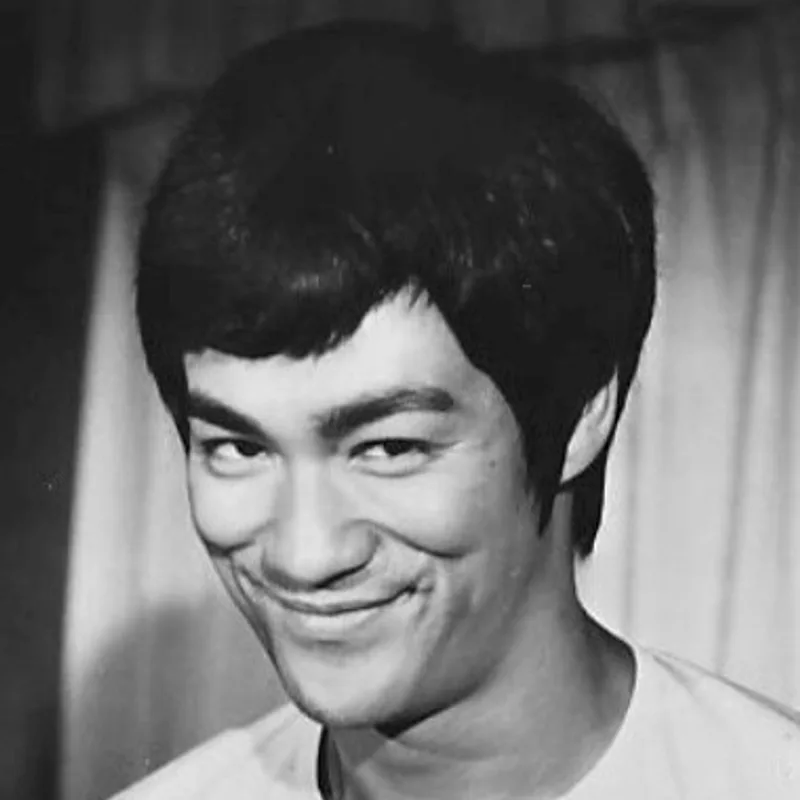
Bruce Lee
Martial artist, Actor, 1940–1973
Atheist, Taoist in outlook
What is the meaning of life?
Life is to be lived, not conceptualized — express yourself.
Lee's notebooks, published after his death as Striking Thoughts (2000), put it in one line: the meaning of life is that it is to be lived, not traded, conceptualized and squeezed into a system. The same idea ran through Jeet Kune Do, the fighting method he built against fixed styles — honestly expressing yourself, actualizing yourself rather than a concept of what you should be. In the 1971 Pierre Berton interview he said that all knowledge is ultimately self-knowledge, and in a 1972 radio interview that what he kept learning was to be yourself and have faith in yourself rather than copy a successful personality. He read Taoism, Zen and Krishnamurti, and many lines in his notes rework older sources, which is why quotes attributed to him need checking.
-
“The meaning of life is that it is to be lived, and it is not to be traded and conceptualized and squeezed into a pattern of systems.”1
-
“Instead of dedicating your life to actualize a concept of what you should be like, ACTUALIZE YOURSELF. The process of maturing does not mean to become a captive of conceptualization. It is to come to the realization of what lies in our innermost selves.”2
-
“When I look around, I always learn something: to be always yourself, and to express yourself, to have faith in yourself. Do not go out and look for a successful personality and duplicate it.”3
What is the meaning of the universe?
No God; one indivisible whole — matter and energy, yin and yang.
Lee's thinking drew on Taoism, Zen and Krishnamurti, but he kept no religion. Asked in a 1972 Hong Kong radio interview about his religious affiliation he answered "None whatsoever", and asked whether he believed in God, "To be perfectly frank, I really do not." His notes describe reality in Taoist terms: matter and energy, yin and yang, heaven and earth as one indivisible whole, with modern physics, in his reading, turning back toward that monism and away from European dualism. In the same notes self and world exist only together — he was not the subject of experience, he wrote, but the experience itself, awareness. His editor John Little calls him an atheist.
-
“To be perfectly frank, I really do not.”4
-
“Taoist philosophy … is essentially monistic. … Matter and energy, Yang and Yin, heaven and earth, are conceived of as essentially one or as two coexistent poles of one indivisible whole.”5
-
“When we hold to the core, the opposite sides are the same if they are seen from the center of the moving circle. I do not experience; I am experience. I am not the subject of experience; I am that experience. I am awareness. Nothing else can be I or can exist.”6