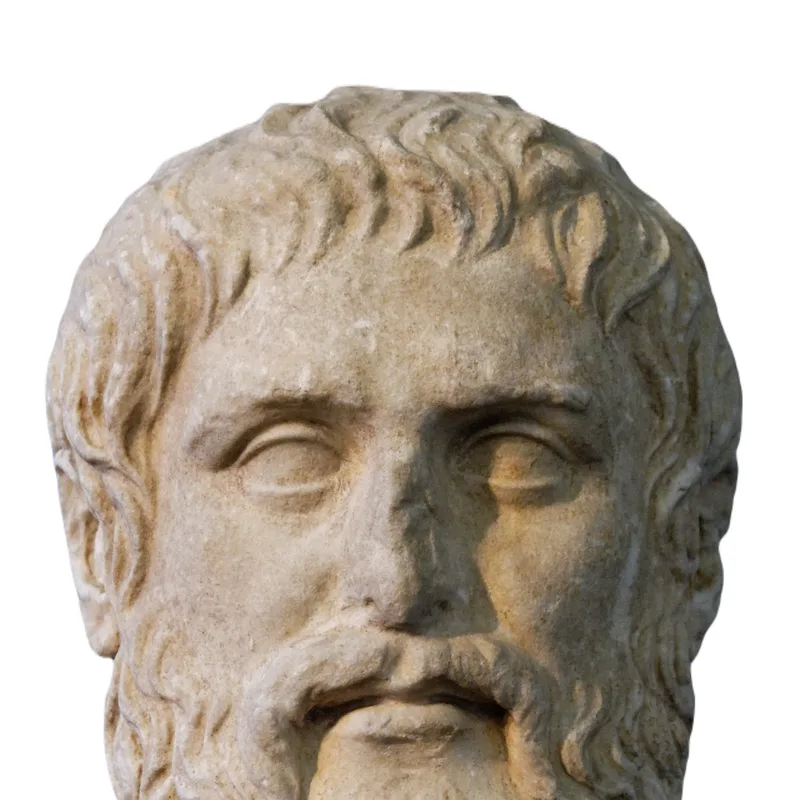
Plato
Philosopher, Founder of the Academy, c. 428 – 347 BC
Idealist
What is the meaning of life?
To rise from shadows to the Good and become like God.
Plato wrote dialogues, not treatises, and never speaks in his own name; his views come through his characters, above all Socrates. In the Republic (c. 375 BC) education is a turning of the whole soul away from the shifting world of the senses toward what truly is, until it can bear the sight of the Good, and the just person, whose soul is in order, is also the happiest. In the Symposium, Diotima, the wise woman Socrates says taught him about love, describes the same climb as love: from one beautiful body to all of them, then to beautiful practices and ideas, and at last to Beauty itself, the life a human being should live. The Theaetetus states the goal as becoming like God as far as possible, which means becoming just, holy and wise, and the Phaedo, set on Socrates' last day, calls philosophy a practice of dying: the release of the soul from the body.
-
“Our argument shows that the power and capacity of learning exists in the soul already; … the instrument of knowledge can only by the movement of the whole soul be turned from the world of becoming into that of being, and learn by degrees to endure the sight of being, and of the brightest and best of being, or in other words, of the good.”1
-
“This, my dear Socrates, … is that life above all others which man should live, in the contemplation of beauty absolute … Remember how in that communion only, beholding beauty with the eye of the mind, he will be enabled to bring forth, not images of beauty, but realities (for he has hold not of an image but of a reality), and bringing forth and nourishing true virtue to become the friend of God and be immortal, if mortal man may.”2
-
“Wherefore we ought to fly away from earth to heaven as quickly as we can; and to fly away is to become like God, as far as this is possible; and to become like him, is to become holy, just, and wise.”3
-
“And the true philosophers, Simmias, are always occupied in the practice of dying, wherefore also to them least of all men is death terrible.”4
What is the meaning of the universe?
Eternal Forms under the Good; a good maker shaped the living cosmos.
Plato divides what exists in two: the visible world, always becoming and never fully being, and the unchanging Forms, which only thought can grasp. Over the Forms stands the Good, which the Republic compares to the sun: as the sun makes things visible and makes them grow, the Good makes the Forms knowable and gives them their being, while itself lying beyond being. In the allegory of the cave, prisoners who have never seen daylight take shadows on a wall for reality, and the climb out stands for the soul's ascent to the intelligible world. The Timaeus (c. 360 BC), whose speaker offers only a likely account, adds a maker: a good craftsman, free of jealousy, brought order out of disorder and made the cosmos as like himself as he could — one living creature with soul and intelligence, with time as a moving image of eternity.
-
“The prison-house is the world of sight, the light of the fire is the sun, and you will not misapprehend me if you interpret the journey upwards to be the ascent of the soul into the intellectual world according to my poor belief, which, at your desire, I have expressed—whether rightly or wrongly God knows.”5
-
“The good may be said to be not only the author of knowledge to all things known, but of their being and essence, and yet the good is not essence, but far exceeds essence in dignity and power.”6
-
“Let me tell you then why the creator made this world of generation. He was good, and the good can never have any jealousy of anything. And being free from jealousy, he desired that all things should be as like himself as they could be. … Wherefore, using the language of probability, we may say that the world became a living creature truly endowed with soul and intelligence by the providence of God.”7
-
“Now the nature of the ideal being was everlasting, but to bestow this attribute in its fulness upon a creature was impossible. Wherefore he resolved to have a moving image of eternity, and when he set in order the heaven, he made this image eternal but moving according to number, while eternity itself rests in unity; and this image we call time.”8