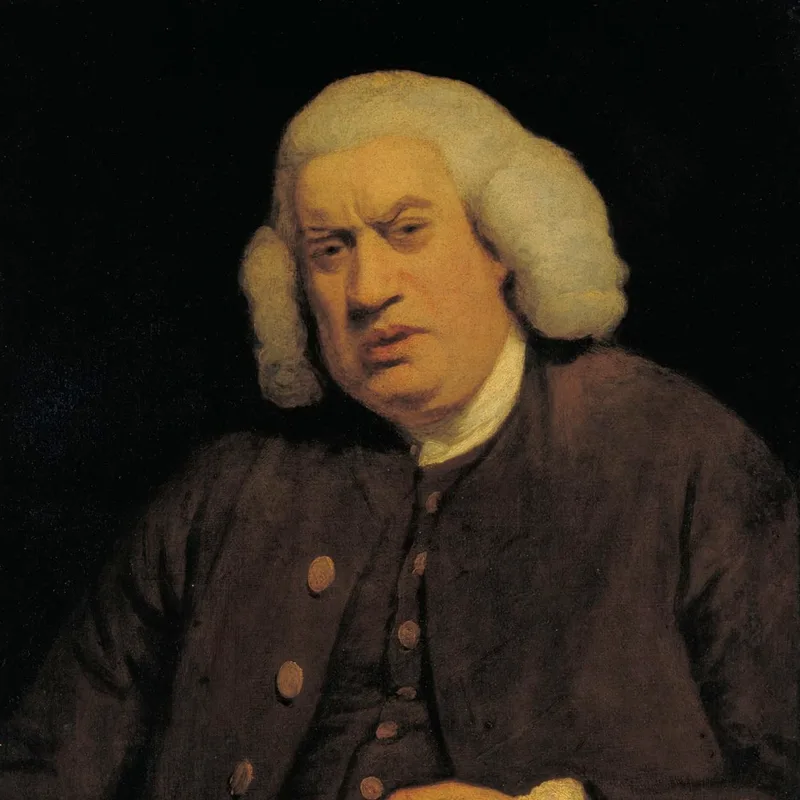
Samuel Johnson
Writer, Lexicographer, 1709–1784
Devout Anglican moralist
What is the meaning of life?
Life moves from want to want, but hope itself is happiness.
Johnson, a bookseller's son from Lichfield, left Oxford without a degree for lack of money and spent years as a struggling hack writer in London before his Dictionary of the English Language (1755) made him famous. In his essays and his novel Rasselas (1759) he examined the search for happiness with a realism shaped by his own poverty, illness and melancholy: life is a progress from want to want, not from enjoyment to enjoyment. Yet he insisted that we must go on hoping, because hope itself is a kind of happiness. James Boswell's Life of Johnson (1791) preserved his talk.
What is the meaning of the universe?
From God we spring, and to God we tend.
Johnson was a devout and anxious Anglican who prayed, fasted and examined his conscience all his life, and who dreaded death and judgment. He had no patience with deists or sceptics, and when Boswell reported that a philosopher had argued for the non-existence of matter, Johnson kicked a stone and said that he refuted it thus. In his English version of a hymn from Boethius he summed up the place of everything in God: we spring from God and tend toward him, who is our path, motive, guide, beginning and end.
-
“From Thee, great God: we spring, to Thee we tend, / Path, motive, guide, original, and end.”3