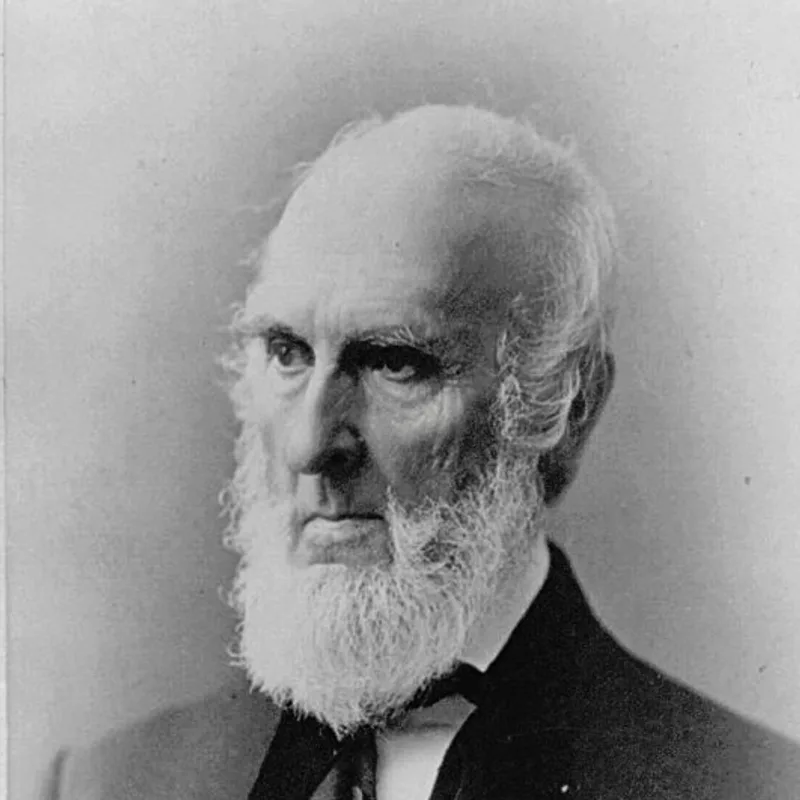
John Greenleaf Whittier
Poet, Abolitionist, 1807–1892
Quaker of the Inner Light
What is the meaning of life?
Live fully now; the saddest words are 'It might have been.'
Whittier grew up on a Quaker farm in Haverhill, Massachusetts, with little schooling; the abolitionist William Lloyd Garrison printed his first poem and drew him into the anti-slavery cause. For three decades he was one of its leading editors, organisers and poets, and faced mobs for it, before Snow-Bound (1866), a memory of a winter of his childhood, made him one of America's best-loved poets. His ballad Maud Muller (1856) tells of a judge and a farm girl who meet once and each later dream of the life they did not choose; its moral is that of all sad words, the saddest are 'It might have been!' He never married, and lived most of his life quietly in Amesbury, Massachusetts, among his fellow Quakers.
-
“For of all sad words of tongue or pen, / The saddest are these: "It might have been!"”1
What is the meaning of the universe?
Whatever we don't know, we cannot drift beyond God's love.
As a Quaker, Whittier trusted the Inner Light, the presence of God in every person, more than any creed. In The Eternal Goodness (1865) he answered friends who defended a stern Calvinist theology: he would not argue doctrine with them, and he knew little about the life to come, but he was sure of God's goodness. Whatever lies beyond our knowledge, he wrote, we cannot drift beyond God's love and care.
-
“I know not where His islands lift / Their fronded palms in air; / I only know I cannot drift / Beyond His love and care.”2