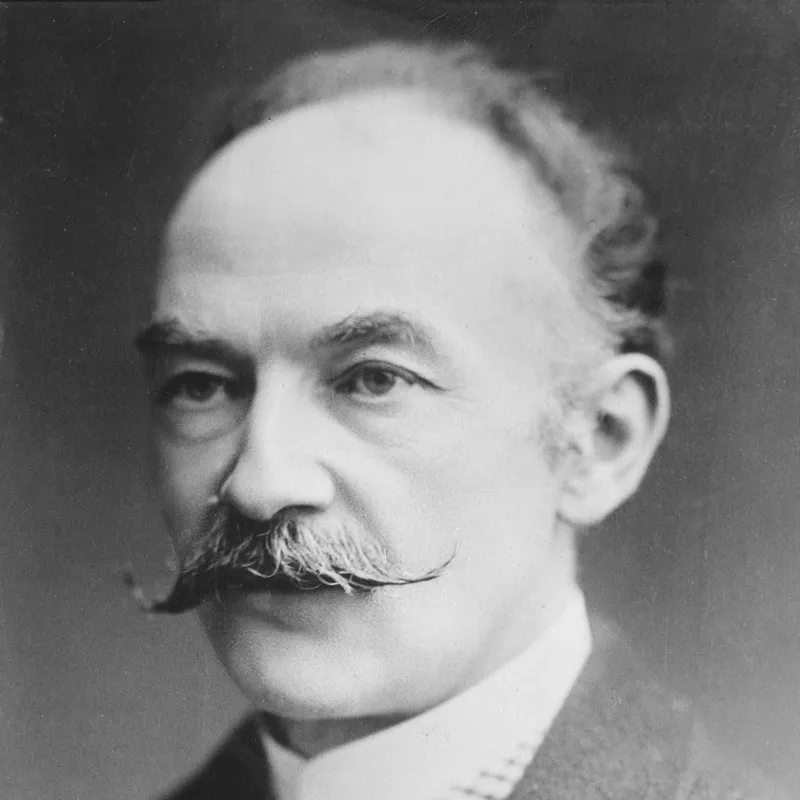
Thomas Hardy
Novelist, Poet, 1840–1928
Agnostic meliorist
What is the meaning of life?
Look the worst full in the face; only then can things improve.
Hardy grew up in rural Dorset, trained as an architect, and wrote novels such as Tess of the d'Urbervilles and Jude the Obscure, whose hostile reception in 1895 led him to give up fiction for poetry. He was often called a pessimist. He answered that he was an evolutionary meliorist: someone who believes the world can be made better, but only by looking honestly at the worst in it. He took that conviction from a line of his own poem “In Tenebris” and quoted it in 1922 to explain himself.
-
“Let him to whose ears the low-voiced Best seems stilled by the clash of the First, / Who holds that if way to the Better there be, it exacts a full look at the Worst, / Who feels that delight is a delicate growth cramped by crookedness, custom, and fear, / Get him up and be gone as one shaped awry; he disturbs the order here.”1
What is the meaning of the universe?
No cruel god rules us, only blind chance and time.
Hardy lost the Christian faith of his youth in his twenties, after reading Darwin and the new biblical criticism, though he kept a lifelong love of church music and ritual. In “Hap”, written in 1866, he says it would almost be a comfort if a vengeful god were laughing at his suffering, since then the pain would at least mean something. But there is no such god: only crass chance and dicing time, which could as easily have strewn blisses as pain. He later wrote of an indifferent force behind the universe, unconscious of what it does.
-
“But not so. How arrives it joy lies slain, / And why unblooms the best hope ever sown? / —Crass Casualty obstructs the sun and rain, / And dicing Time for gladness casts a moan . . . / These purblind Doomsters had as readily strown / Blisses about my pilgrimage as pain.”2