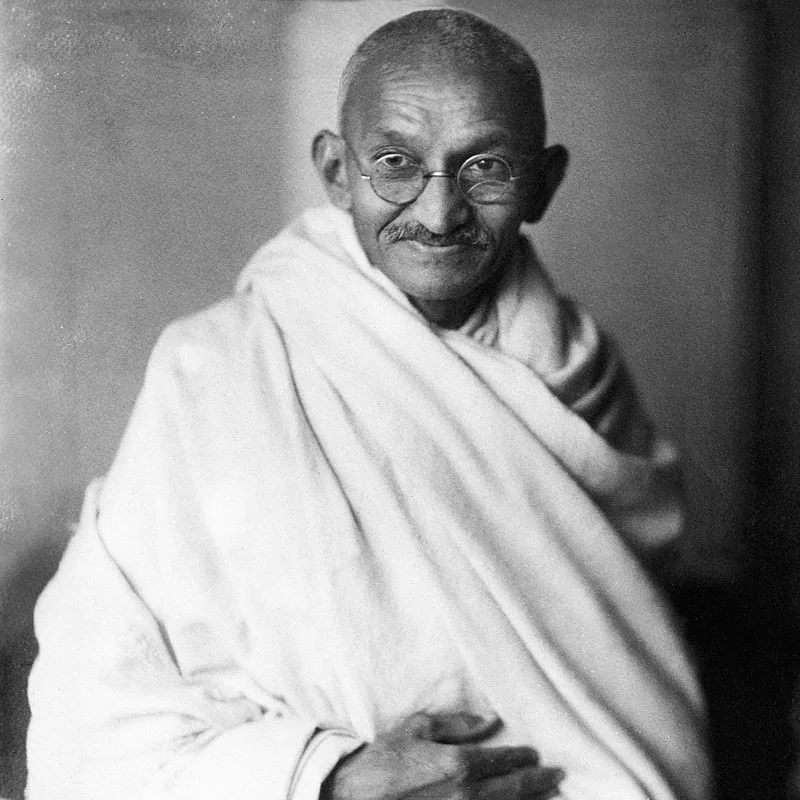
Mahatma Gandhi
Indian independence leader, Advocate of nonviolence, 1869–1948
Hindu
What is the meaning of life?
To see God face to face — by serving all that lives.
Gandhi's answer was religious and practical at once. In the introduction to his autobiography, The Story of My Experiments with Truth, serialised from 1925, he named the goal he had pursued for thirty years: self-realisation, to see God face to face, to attain moksha. Everything else, his politics included, was directed to that end. Because he held that God is present in every being, the road ran through other people: in Harijan in 1936 he wrote that the only way to find God is to see him in his creation, and that he could not find him apart from the rest of humanity. The means was ahimsa, nonviolence understood as love even for the least of creatures; a seeker of truth, he concluded, cannot keep out of any field of life.
-
“What I want to achieve,—what I have been striving and pining to achieve these thirty years,—is self-realisation, to see God face to face, to attain Moksha. I live and move and have my being in pursuit of this goal. All that I do by way of speaking and writing, and all my ventures in the political field, are directed to this same end.”1
-
“Man's ultimate aim is the realization of God, and all his activities, social, political, religious, have to be guided by the ultimate aim of the vision of God. The immediate service of all human beings becomes a necessary part of the endeavour, simply because the only way to find God is to see Him in his creation and be one with it.”2
-
“To see the universal and all-pervading Spirit of Truth face to face one must be able to love the meanest of creation as oneself. And a man who aspires after that cannot afford to keep out of any field of life.”3
What is the meaning of the universe?
Truth is God — a living Power that holds all together.
Gandhi was raised in a Vaishnava Hindu family, studied other religions closely, and believed God to be without form. In Young India in 1928 he described an indefinable Power that pervades everything — felt, not seen, beyond proof — a changeless living Power under all change that holds everything together, creates, dissolves and recreates. He said he had no argument to convince anyone by reason: faith transcends reason. For years he had said that God is Truth; in a speech at Lausanne in 1931 he said he had gone a step further, to Truth is God, partly because even atheists did not deny the necessity of truth. Since God is one and in everyone, he held that humanity, too, has one soul.
-
“There is an indefinable mysterious Power that pervades everything. I feel It though I do not see It. It is this unseen Power which makes Itself felt and yet defies all proof, because It is so unlike all that I perceive through my senses. It transcends the senses.”4
-
“I do dimly perceive that whilst everything around me is ever changing, ever dying, there is underlying all that change a living Power that is changeless, that holds all together, that creates, dissolves and recreates. That informing Power or Spirit is God. And since nothing else I see merely through the senses can or will persist, He alone is.”4
-
“But deep down in me I used to say that though God may be Love, God is Truth, above all. If it is possible for the human tongue to give the fullest description of God, I have come to the conclusion that for myself, God is Truth. But two years ago I went a step further and said that Truth is God.”5
-
“I believe in absolute oneness of God and therefore also of humanity. What though we have many bodies? We have but one soul. The rays of the sun are many through refraction. But they have the same source.”6