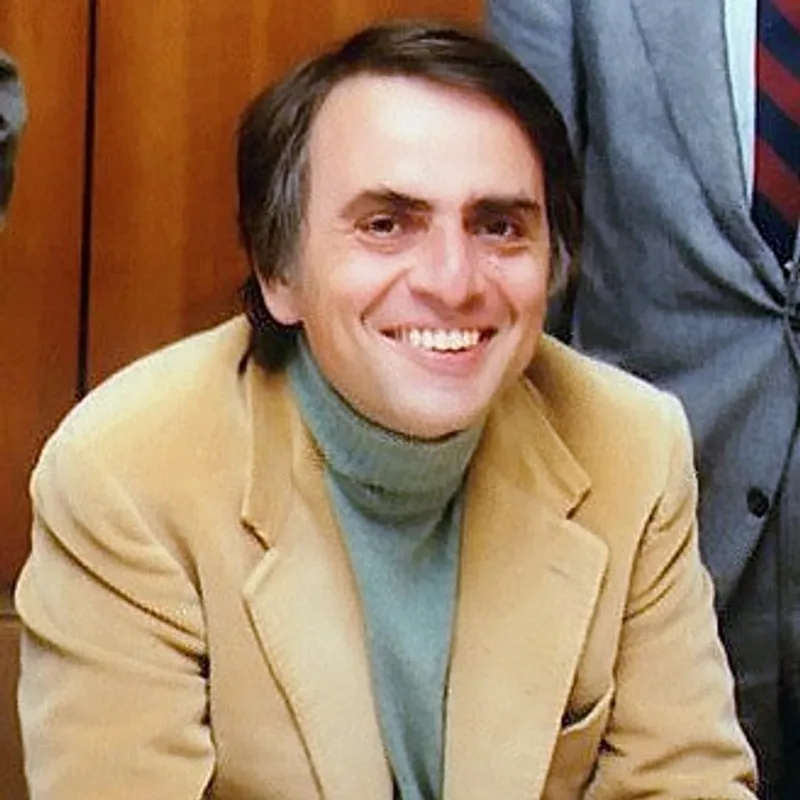
Carl Sagan
Astronomer, Science communicator, 1934–1996
Agnostic
What is the meaning of life?
A brief, magnificent opportunity; deal kindly with one another.
Sagan did not believe in an afterlife and said so plainly while he was dying: much as he would love to live again, he knew of nothing to suggest it was more than wishful thinking. The response he drew from this, in the essay collected in Billions and Billions (1997), was gratitude for the brief but magnificent opportunity that life provides. The view from outside, which he spent his career describing, carried an ethic for him. Looking at the Voyager photograph of Earth as a point of light in Pale Blue Dot (1994), he concluded that it underscored our responsibility to deal more kindly with one another and to cherish the only home we have. In his novel Contact he put the rest in one line: for small creatures such as we, the vastness is bearable only through love.
-
“The world is so exquisite, with so much love and moral depth, that there is no reason to deceive ourselves with pretty stories for which there's little good evidence. Far better, it seems to me, in our vulnerability, is to look Death in the eye and to be grateful every day for the brief but magnificent opportunity that life provides.”1
-
“There is perhaps no better demonstration of the folly of human conceits than this distant image of our tiny world. To me, it underscores our responsibility to deal more kindly with one another, and to preserve and cherish the pale blue dot, the only home we've ever known.”2
-
“For small creatures such as we the vastness is bearable only through love.”3
What is the meaning of the universe?
The cosmos is all there is; we are how it knows itself.
Sagan opened Cosmos (1980) with a definition: the Cosmos is all that is or ever was or ever will be. Humans are part of it, made of star-stuff, and in his phrase a way for the cosmos to know itself. He refused the label atheist, since an atheist would need compelling evidence that God does not exist and he knew of none; certainty either way struck him as the confident extremes of a subject riddled with doubt, and he called himself an agnostic. What he did reject was any picture that put humans at the centre of things, and the habit of believing something because it felt good. For him it was far better to grasp the Universe as it really is than to persist in delusion, however reassuring.
-
“The Cosmos is all that is or ever was or ever will be. Our feeblest contemplations of the Cosmos stir us — there is a tingling in the spine, a catch in the voice, a faint sensation as if a distant memory, of falling from a height. We know we are approaching the greatest of mysteries.”4
-
“Some part of our being knows this is where we came from. We long to return. And we can. Because the cosmos is also within us. We're made of star-stuff. We are a way for the cosmos to know itself.”5
-
“An atheist is someone who is certain that God does not exist, someone who has compelling evidence against the existence of God. I know of no such compelling evidence. … To be certain of the existence of God and to be certain of the nonexistence of God seem to me to be the confident extremes in a subject so riddled with doubt and uncertainty as to inspire very little confidence indeed.”6