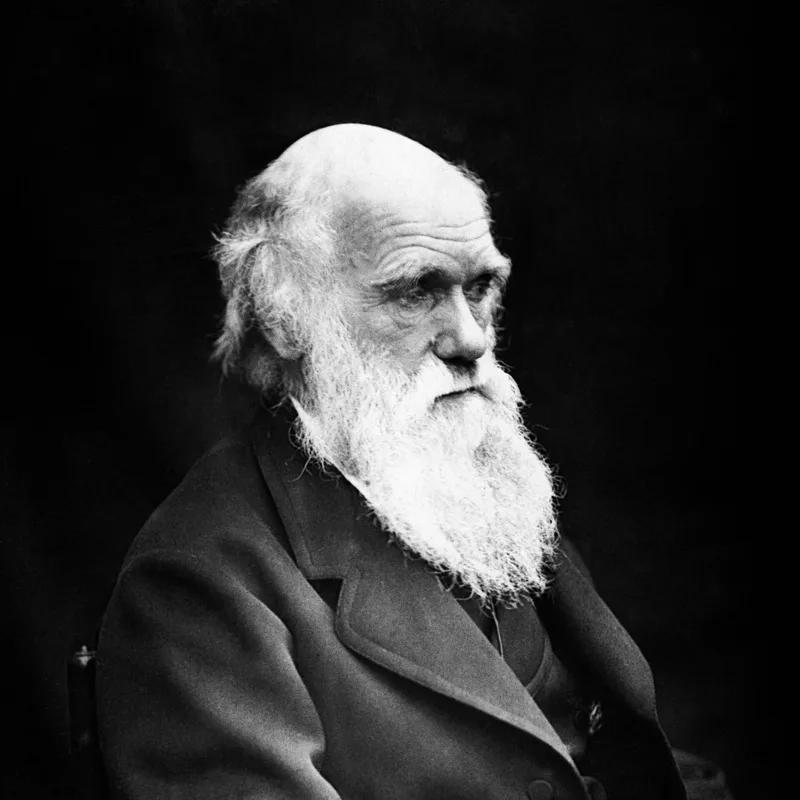
Charles Darwin
Naturalist, Biologist, 1809–1882
Agnostic
What is the meaning of life?
Observe, reason, and do your duty; the rest is beyond us.
Darwin did not think the purpose of life could be settled by human reason. Asked by a Dutch student in 1873 on what grounds he believed in God, he answered that the whole subject was beyond the scope of man's intellect, but that man can do his duty. Duty, for him, had a natural history: in The Descent of Man he traced the moral sense to social instincts which, sharpened by reason and habit, lead to the golden rule. His own life he described in the Autobiography, written in 1876, as a slow shift from sport to science, the pleasure of observing and reasoning turning out to be higher than any other. The last paragraph of the Origin shows what he found in the process itself: grandeur in endless forms evolving from so simple a beginning.
-
“The safest conclusion seems to be that the whole subject is beyond the scope of man's intellect; but man can do his duty.”1
-
“The moral sense perhaps affords the best and highest distinction between man and the lower animals; but I need say nothing on this head, as I have so lately endeavoured to shew that the social instincts,—the prime principle of man's moral constitution—with the aid of active intellectual powers and the effects of habit, naturally lead to the golden rule, "As ye would that men should do to you, do ye to them likewise;" and this lies at the foundation of morality.”2
-
“I discovered, though unconsciously and insensibly, that the pleasure of observing and reasoning was a much higher one than that of skill and sport.”3
-
“There is grandeur in this view of life, with its several powers, having been originally breathed into a few forms or into one; and that, whilst this planet has gone cycling on according to the fixed law of gravity, from so simple a beginning endless forms most beautiful and most wonderful have been, and are being, evolved.”4
What is the meaning of the universe?
Everything the result of fixed laws; the first cause unknowable.
Darwin began as an orthodox Christian who meant to become a clergyman, and he once found Paley's argument from design conclusive. Natural selection dissolved it for him: there was no more design in the variation of living things than in the way the wind blows. Writing to Asa Gray in 1860 he said he could not see evidence of design and beneficence around him — a God would not have made wasps to feed inside living caterpillars — yet he could not believe the universe was the result of brute force either, and settled for designed laws with the details left to chance. In the Autobiography he recorded that his sense of a First Cause with an intelligent mind had been strong when he wrote the Origin and had weakened since, and he doubted whether a mind evolved from animal minds could be trusted on such questions. In 1879 he told John Fordyce that he had never been an atheist and that agnostic described him best.
-
“I am inclined to look at everything as resulting from designed laws, with the details, whether good or bad, left to the working out of what we may call chance. Not that this notion at all satisfies me. I feel most deeply that the whole subject is too profound for the human intellect. A dog might as well speculate on the mind of Newton. Let each man hope and believe what he can.”5
-
“The old argument of design in nature, as given by Paley, which formerly seemed to me so conclusive, fails, now that the law of natural selection has been discovered. We can no longer argue that, for instance, the beautiful hinge of a bivalve shell must have been made by an intelligent being, like the hinge of a door by man. There seems to be no more design in the variability of organic beings and in the action of natural selection, than in the course which the wind blows. Everything in nature is the result of fixed laws.”6
-
“Thus reflecting, I feel compelled to look to a First Cause having an intelligent mind in some degree analogous to that of man, and I deserve to be called a Theist. This conclusion was strong in my mind about the time, as far as I can remember, when I wrote the Origin of Species; and it is since that time that it has very gradually with many fluctuations become weaker. … The mystery of the beginning of all things is insoluble by us; and I for one must be content to remain an Agnostic.”3
-
“It seems to me absurd to doubt that a man may be an ardent Theist & an evolutionist. … In my most extreme fluctuations I have never been an atheist in the sense of denying the existence of a God. I think that generally (& more and more so as I grow older) but not always, that an agnostic would be the most correct description of my state of mind.”7