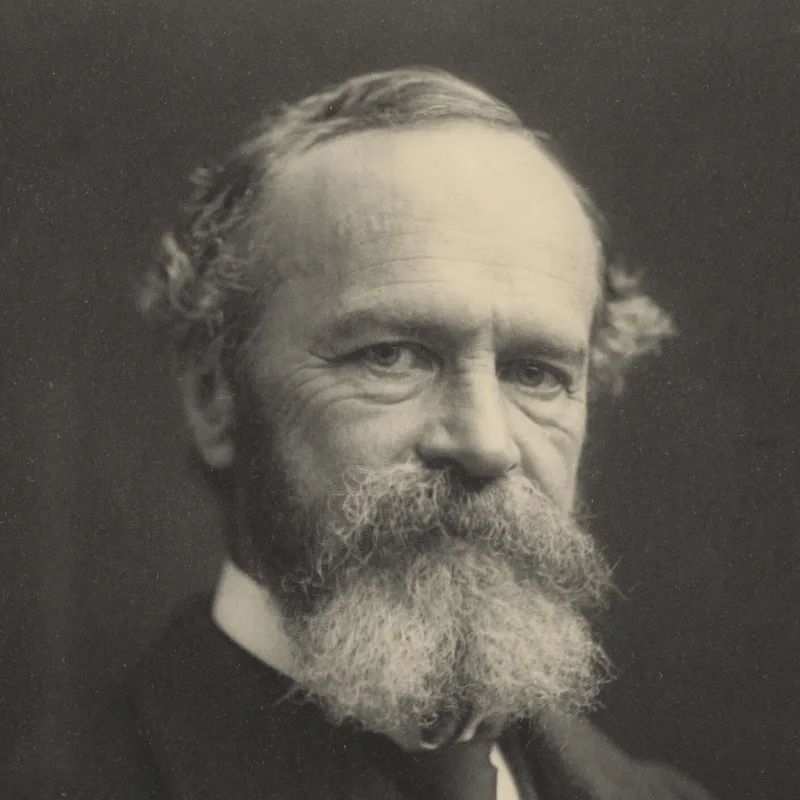
William James
Philosopher, Psychologist, 1842–1910
Pragmatist believer
What is the meaning of life?
Believe life is worth living, and the belief helps make it so.
James, a founder of American psychology and of pragmatism, went through a long depression in his twenties and came out of it by resolving that his first act of free will would be to believe in free will. In his 1895 lecture Is Life Worth Living? he argued that the question cannot be settled by evidence in advance: faith that life is worth living helps to make it so. A life is significant, he told teachers a few years later, when an ideal is joined to courage and endurance. Meaning, for him, was something risked and made in action, not found ready-made.
-
“Be not afraid of life. Believe that life is worth living, and your belief will help create the fact.”1
-
“The solid meaning of life is always the same eternal thing,—the marriage, namely, of some unhabitual ideal, however special, with some fidelity, courage, and endurance; with some man's or woman's pains.”2
What is the meaning of the universe?
A finite God who needs our help, in an unfinished universe.
In The Varieties of Religious Experience (1902), a study of conversions, mystics and saints, James judged religion by its fruits and concluded that such experiences point to a 'more': a wider spiritual reality continuous with our own minds. In Pragmatism (1907) he applied the same test to God: if the belief works in the widest sense, it is true. He set aside the all-powerful God of the theologians for a finite one, in a pluralistic and unfinished universe whose outcome depends partly on what each of us does.
-
“The universe, at those parts of it which our personal being constitutes, takes a turn genuinely for the worse or for the better in proportion as each one of us fulfills or evades God's demands.”3
-
“On pragmatistic principles, if the hypothesis of God works satisfactorily in the widest sense of the word, it is true.”4