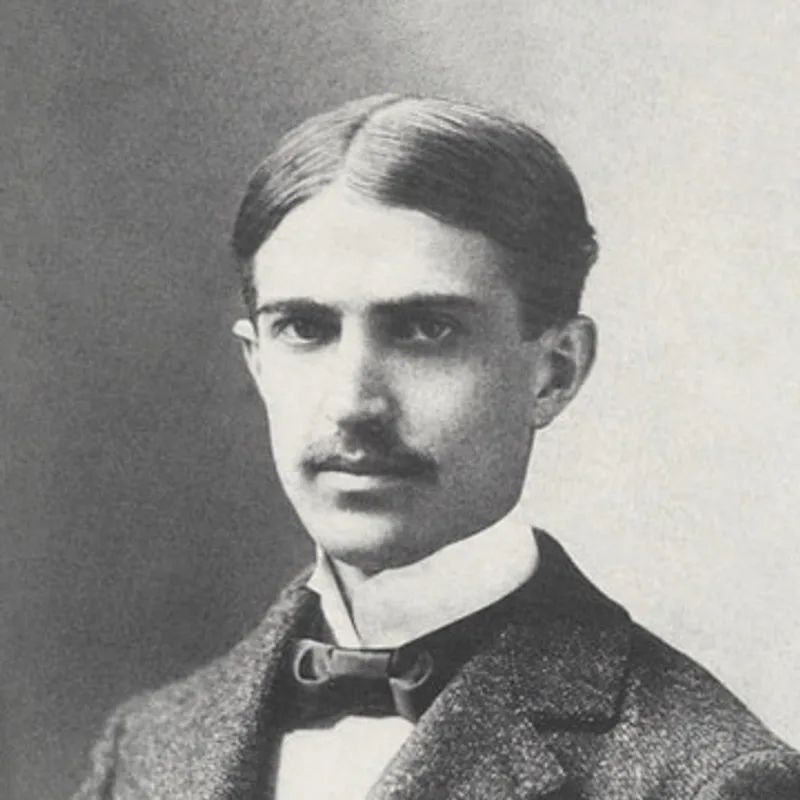
Stephen Crane
Novelist, Poet, Journalist, 1871–1900
Doubter, son of a minister
What is the meaning of life?
Keep pursuing the horizon, even when told it is futile.
Crane, the fourteenth child of a Methodist minister, worked as a reporter in New York's slums, wrote The Red Badge of Courage (1895), the most famous American novel of the Civil War, before he had ever seen a battle, and later covered wars in Greece and Cuba; after surviving a shipwreck that became the story “The Open Boat”, he died of tuberculosis at twenty-eight. His short, strange poems, which he called lines, are parables about striving against impossible odds. In one, a man runs round and round pursuing the horizon; told that it is futile, he answers “You lie” and runs on.
-
“I saw a man pursuing the horizon; / Round and round they sped. / I was disturbed at this; / I accosted the man. / “It is futile,” I said, / “You can never—” / “You lie,” he cried, / And ran on.”1
What is the meaning of the universe?
The universe owes us nothing; our existence obliges it to nothing.
Crane grew up surrounded by ministers, and his poems keep arguing with the God of his parents: some reject a God of wrath who punishes children for the sins of their fathers, others reach for a gentler God of the inner heart. In his fiction nature itself is indifferent: in “The Open Boat” a shipwrecked man realises that nature does not regard him as important. The universe, in one of his best-known poems, answers a man's proud “Sir, I exist!” with a shrug: the fact has not created in it a sense of obligation.
-
“A man said to the universe: / “Sir I exist!” / “However,” replied the universe, / “The fact has not created in me / A sense of obligation.””2