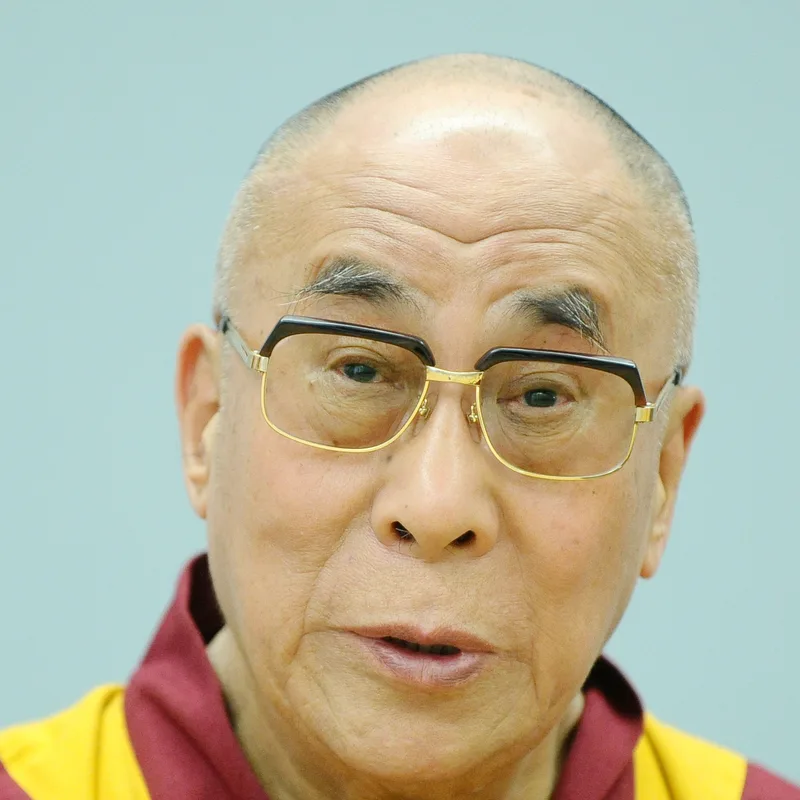
Dalai Lama
Spiritual leader of Tibetan Buddhism, Buddhist monk, born 1935
Tibetan Buddhist
What is the meaning of life?
To be happy — through love and compassion for others.
Tenzin Gyatso, the fourteenth Dalai Lama, in exile in India since 1959, gives an answer meant to hold whether one is religious or not. In the essay Compassion and the Individual (1991) he wrote that the purpose of life is to be happy: from birth every human being wants happiness and does not want suffering, whatever their upbringing or ideology. Because the mind matters more than the body, the greatest happiness, in his experience, comes from love and compassion — the more we care for the happiness of others, the greater our own well-being. His own religion, he once said, is simple: the heart is the temple and the philosophy is kindness.
-
“I believe that the purpose of life is to be happy. From the moment of birth, every human being wants happiness and does not want suffering. Neither social conditioning nor education nor ideology affect this. From the very core of our being, we simply desire contentment.”1
-
“From my own limited experience I have found that the greatest degree of inner tranquility comes from the development of love and compassion. The more we care for the happiness of others, the greater our own sense of well-being becomes.”1
-
“This is my simple religion. There is no need for temples; no need for complicated philosophy. Our own brain, our own heart is our temple; the philosophy is kindness.”2
What is the meaning of the universe?
No creator: a beginningless universe of interdependent causes.
As a Buddhist of the Gelug school he does not accept a creator God; in his Nobel evening address in 1989 he said that, for Buddhism, one's own actions are ultimately the creator. In The Universe in a Single Atom (2005), his book on Buddhism and modern science, he argued that an absolute beginning would leave only two options, a transcendent creator or a universe arising from no cause at all, and that Buddhism rejects both: the universe is beginningless. What runs through everything is interdependence, which he calls a fundamental law of nature — everything from the planet to the flowers arises in dependence on subtle patterns of energy and decays without them. Whether the universe as a whole has a deeper meaning, he says he does not know.
-
“Buddhism does not accept a theory of God, or a creator. According to Buddhism, one's own actions are the creator, ultimately.”3
-
“From the Buddhist perspective, the idea that there is a single definite beginning is highly problematic. If there were such an absolute beginning, logically speaking, this leaves only two options. One is theism, which proposes that the universe is created by an intelligence that is totally transcendent, and therefore outside the laws of cause and effect. The second option is that the universe came into being from no cause at all. Buddhism rejects both these options.”4
-
“Inter-dependence, of course, is a fundamental law of nature. … The most subtle level of material phenomena is also governed by interdependence. All phenomena from the planet we inhabit to the oceans, clouds, forests and flowers that surround us, arise in dependence upon subtle patterns of energy. Without their proper interaction, they dissolve and decay.”1
-
“I don't know whether the universe, with its countless galaxies, stars and planets, has a deeper meaning or not, but at the very least, it is clear that we humans who live on this earth face the task of making a happy life for ourselves.”1