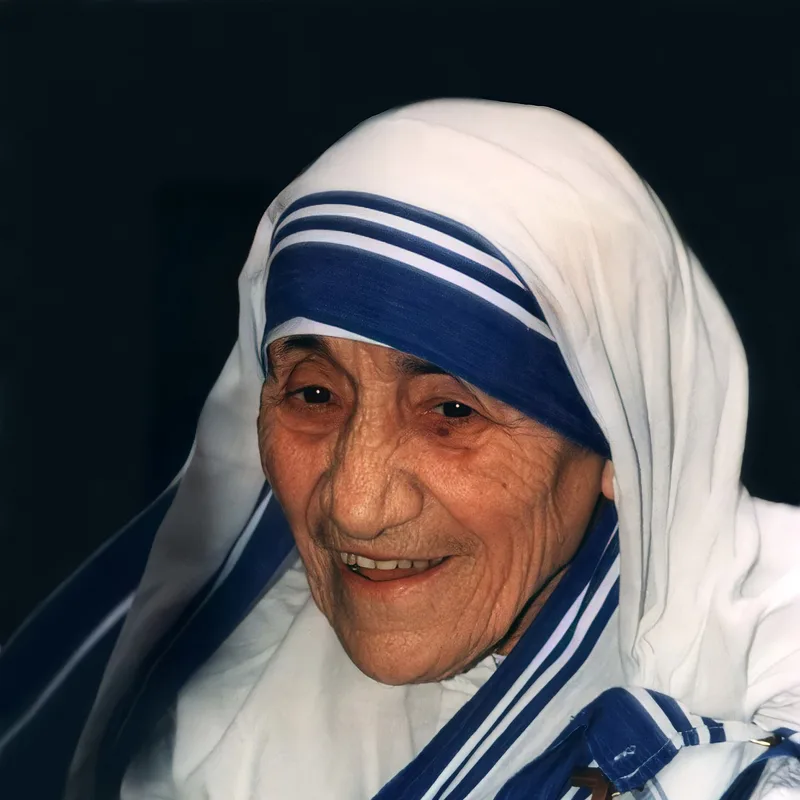
Mother Teresa
Catholic nun, Founder of the Missionaries of Charity, 1910–1997
Catholic
What is the meaning of life?
To love and be loved, and to serve Jesus in the poorest.
Mother Teresa was born in Skopje in 1910 to an Albanian family, joined the Sisters of Loreto, and in 1950 founded the Missionaries of Charity in Calcutta to serve the poorest of the poor. Her answer to what life is for was the Christian one, taken literally: we have been created in God's image to love and be loved. In her Nobel lecture in 1979 she said that love begins at home, and that what matters is not how much we do but how much love we put into it, because God is infinite and the size of the work means nothing to him. Love, to be true, she added, has to hurt.
-
“Our hunger for God, because we have been created for that love. We have been created in his image. We have been created to love and be loved, and then he has become man to make it possible for us to love as he loved us.”1
-
“Love begins at home, and it is not how much we do, but how much love we put in the action that we do. It is to God Almighty – how much we do it does not matter, because He is infinite, but how much love we put in that action. How much we do to Him in the person that we are serving.”1
What is the meaning of the universe?
A God of love, present in the poor, and felt as darkness.
Her universe was the Catholic one: God made human beings in his image, out of love, and became man in Jesus. In the Nobel lecture she said that Jesus makes himself the hungry, the naked, the sick and the unwanted, so that what is done to them is done to him; her work rested on seeing him in the poorest. Her letters, which she had asked to be destroyed, were published in 2007 as Come Be My Light and show another side. For nearly fifty years she felt God's absence; she wrote of the pain of God not wanting her, of God not being God, of God not really existing, and asked forgiveness for the blasphemy. She accepted the darkness and went on with her work.
-
“He makes himself the hungry one – the naked one – the homeless one – the sick one – the one in prison – the lonely one – the unwanted one – and he says: You did it to me. Hungry for our love, and this is the hunger of our poor people.”1
-
“In my soul I feel just that terrible pain of loss, of God not wanting me, of God not being God, of God not really existing (Jesus, please forgive my blasphemies, I have been told to write everything). That darkness that surrounds me on all sides. I can't lift my soul to God – no light or inspiration enters my soul.”2
-
“The moment passed — but the darkness is so dark, and the pain is so painful. – But I accept whatever He gives and I give whatever He takes.”3