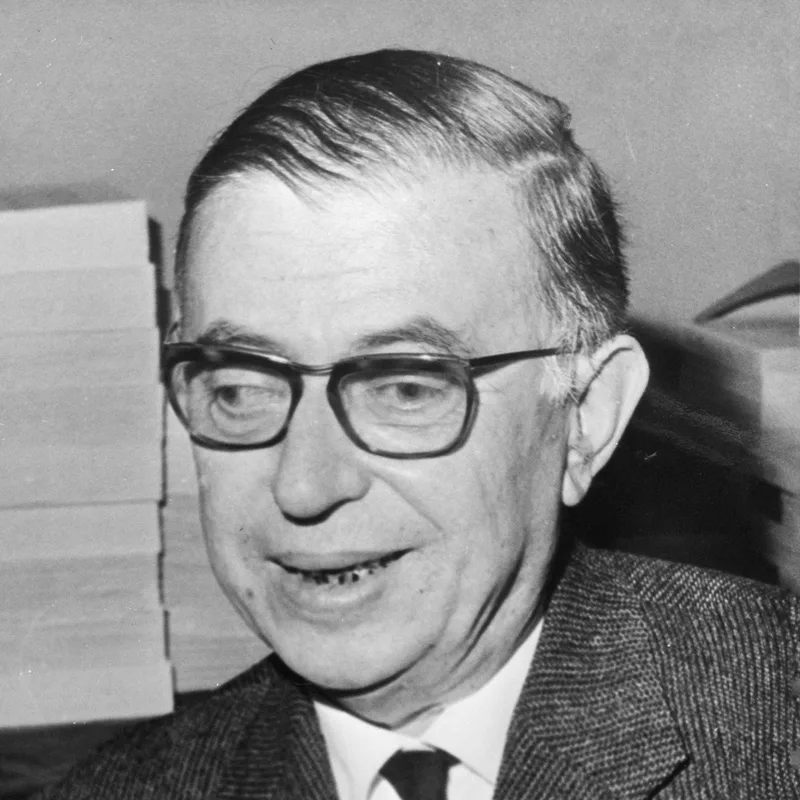
Jean-Paul Sartre
Philosopher, Novelist, Playwright, 1905–1980
Atheist existentialist
What is the meaning of life?
No given meaning: you make one, and you answer for it.
Sartre's answer comes from his 1945 lecture Existentialism Is a Humanism. There is no human nature, because there is no God to have designed one: existence precedes essence, and a person is nothing until he makes himself something through his choices. Life has no meaning in advance; it is up to each of us to give it one, and value is nothing but the meaning we choose. That freedom is total and so is the responsibility, which is why he called it a condemnation and spoke of anguish and abandonment. He insisted the doctrine was not despair but action: we are what we do, and nothing — not even a proof of God — could save us from ourselves.
-
“Life has no meaning a priori … It is up to you to give it a meaning, and value is nothing but the meaning that you choose.”1
-
“What do we mean by saying that existence precedes essence? We mean that man first of all exists, encounters himself, surges up in the world—and defines himself afterwards. … He will not be anything until later, and then he will be what he makes of himself. Thus, there is no human nature, because there is no God to have a conception of it.”1
-
“Dostoevsky once wrote: "If God did not exist, everything would be permitted"; and that, for existentialism, is the starting point. Everything is indeed permitted if God does not exist, and man is in consequence forlorn, for he cannot find anything to depend upon either within or outside himself. He discovers forthwith, that he is without excuse.”1
What is the meaning of the universe?
No God; brute, contingent being, and us trying to found ourselves.
Sartre was an atheist, but he did not spend much effort disproving God. Existentialism, he said, simply draws the full conclusions from God's absence: no given human nature, no values written anywhere, no one to blame. In Being and Nothingness (1943) he described the universe as brute being-in-itself — contingent, superfluous, without reason — against which human consciousness is a lack that keeps trying to become its own foundation; the idea of God, he argued, is the name for that impossible project, which is why man is a useless passion. Even if God existed, he added in 1945, it would change nothing for existentialism, because the real problem is not God's existence but our own. The nausea his first novel is named for is the feeling of that contingency: things existing for no reason.
-
“And when we speak of "abandonment" - a favorite word of Heidegger - we only mean to say that God does not exist and that it is necessary to draw the consequences of his absence to the end.”1
-
“Existentialism is nothing else but an attempt to draw the full conclusions from a consistently atheistic position. … Existentialism is not atheist in the sense that it would exhaust itself in demonstrations of the non-existence of God. It declares, rather, that even if God existed that would make no difference from its point of view. Not that we believe God does exist, but we think that the real problem is not that of His existence; what man needs is to find himself again and to understand that nothing can save him from himself …”1
-
“Thus the passion of man is the reverse of that of Christ, for man loses himself as man in order that God may be born. But the idea of God is contradictory and we lose ourselves in vain. Man is a useless passion.”2