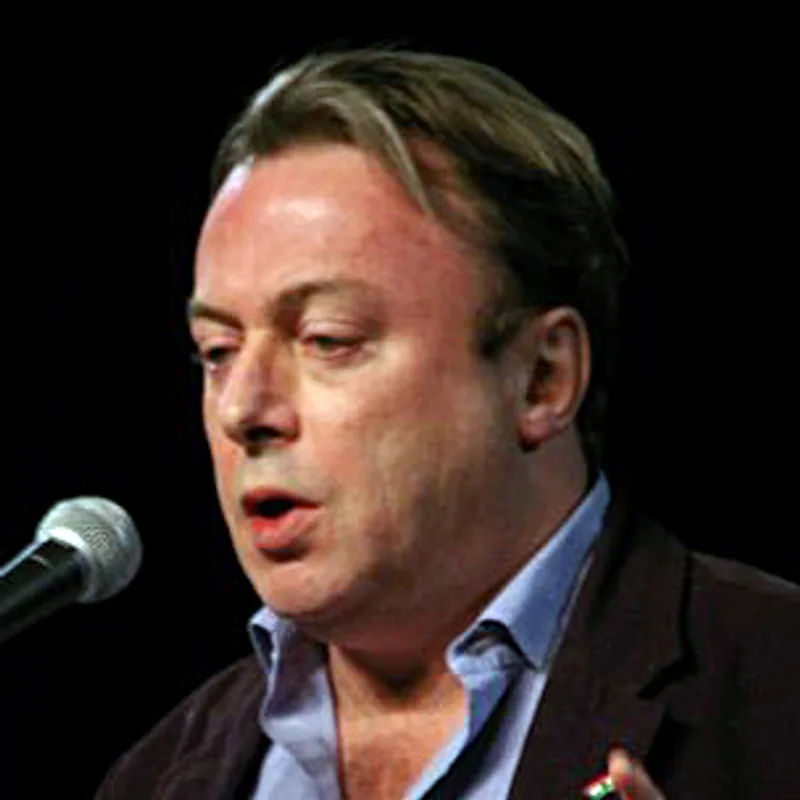
Christopher Hitchens
Journalist, Essayist, 1949–2011
Anti-theist
What is the meaning of life?
Argue, inquire, think for yourself, and treasure your friends.
Hitchens saw no plan behind human life, so its worth lay in what people make of it: argument, inquiry and friendship. In Letters to a Young Contrarian (2001) he urged readers to shun the "transcendent", to seek out argument for its own sake and never to be spectators of unfairness or stupidity, since the grave would supply plenty of time for silence. Closing a 2010 debate on God, he called the conversation about what is good, beautiful, noble and true the only one worth having, and said he would rather live never knowing enough than accept the offer of certainty. After his diagnosis with oesophageal cancer in 2010 he wrote that his chief consolation was the presence of friends; the essays about his illness were published after his death as Mortality (2012).
-
“The discussion about what is good, what is beautiful, what is noble and what is pure and what is true can always go on. Why is that important, why would I like to do that? Because that is the only conversation worth having. … Take the risk of thinking for yourself. Much more happiness, truth, beauty and wisdom will come to you that way.”1
-
“Beware the irrational, however seductive. Shun the 'transcendent' and all who invite you to subordinate or annihilate yourself. … Never be a spectator of unfairness or stupidity. Seek out argument and disputation for their own sake; the grave will supply plenty of time for silence.”2
-
“My chief consolation in this year of living dyingly has been the presence of friends.”3
What is the meaning of the universe?
No God, no design: a cosmos that doesn't know we're here.
Hitchens called himself an anti-theist: he saw no evidence for God and thought it would be awful if there were one, a permanent divine supervision of every waking and sleeping moment. In God Is Not Great (2007) he argued that religion comes from the fearful infancy of our species, when no one had the smallest idea how nature worked. In a 2007 talk at Google he said that neither the explosion that set the universe in motion nor the long course of evolution was designed with us in mind, and in a 2009 debate he added that even a first cause would not prove that anything out there cares about us. When cancer came he dismissed the question "Why me?": the cosmos, he wrote, barely bothers to reply.
-
“We can be as sure as we could probably need be that neither this enormous explosion that set the universe in motion, which is still moving away from us at a great rate, nor this amazingly complex billion year period of evolution, we can be pretty certain it was not designed so that you and I could be meeting in this room. We are not the objects of either of these plans. These plans don't know we're here.”4
-
“I say I'm an anti-theist because I think it would be rather awful if it was true. If there was a permanent, total, around-the-clock, divine supervision...an invigilation of everything you did...you would never have a waking or sleeping moment where you weren't being watched and controlled and supervised by some celestial entity … It would be like living in North Korea.”5
-
“To the dumb question "Why me?" the cosmos barely bothers to return the reply: Why not?”6