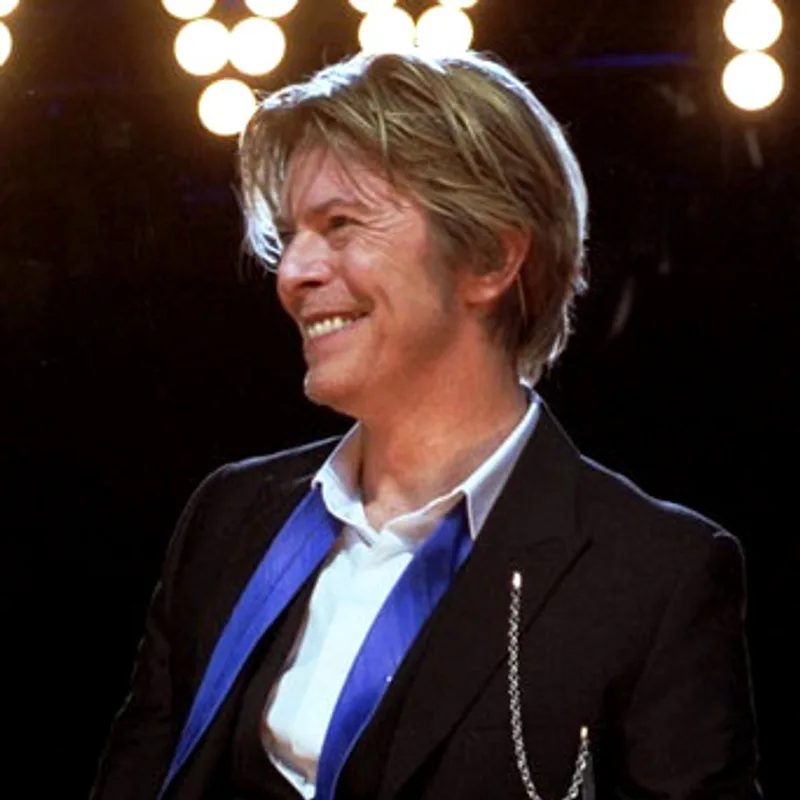
David Bowie
Singer-songwriter, Actor, 1947–2016
Not quite an atheist
What is the meaning of life?
To keep asking, and become who you should have been.
Bowie never offered a doctrine. He said in 2003 that his original questions had not changed, there were just fewer of them, and that questioning his spiritual life had always been at the centre of his writing. In a 1997 Q interview he said the only thing that fascinated him was the stretch of time between that day and his death, and that what he needed was a spiritual balance between how he lived and his dying. Music, he told Berklee graduates in 1999, had been his doorway of perception and the house he lived in. In his fifties he described ageing as becoming the person you always should have been, and admitted the clichés were true: life really is as short as they say.
-
“What I need is to find a balance, spiritually, with the way I live and my demise. And that period of time, from today until my demise, is the only thing that fascinates me.”1
-
“Music has given me over 40 years of extraordinary experiences. I can't say that life's pains or more tragic episodes have been diminished because of it. But it's allowed me so many moments of companionship when I've been lonely and a sublime means of communication when I wanted to touch people. It's been both my doorway of perception and the house that I live in.”2
-
“If you are pining for youth I think it produces a stereotypical old man because you only live in memory, you live in a place that doesn't exist … I think ageing is an extraordinary process whereby you become the person that you always should have been.”3
-
“That's the shock: All clichés are true. The years really do speed by. Life really is as short as they tell you it is. And there really is a God—so do I buy that one?”4
What is the meaning of the universe?
Between atheism and a kind of gnosticism, never settling.
Bowie's religious life was a long oscillation. In 1967 he studied Tibetan Buddhism in London and considered becoming a monk; his teacher told him to follow music instead. In 1975, at the low point of his cocaine years, he said he felt totally alone because he had pretty much abandoned God, and in the 1990s he spoke again of a belief in God and recited the Lord's Prayer on stage. In 1997 he described the common ground of his songs as a need to vacillate between atheism and a kind of gnosticism, with no empathy for organised religion. Heathen (2002) pictures a man who can no longer feel any god's presence. His last word on the subject, in 2003, was that he was not quite an atheist, and that this worried him.
-
“I guess the common ground with all the songs is this abiding need in me to vacillate between atheism or a kind of Gnosticism. I keep going backwards and forwards between the two things, because they mean a lot in my life. I mean, the church doesn't enter into my writing, or my thought; I have no empathy with any organized religions.”1
-
“Heathenism is a state of mind. You can take it that I'm referring to one who does not see his world. He has no mental light. He destroys almost unwittingly. He cannot feel any Gods' presence in his life. He is the 21st century man.”5
-
“Questioning my spiritual life has always been germane to what I was writing. Always. It's because I'm not quite an atheist and it worries me. There's that little bit that holds on: Well, I'm almost an atheist. Give me a couple of months.”4