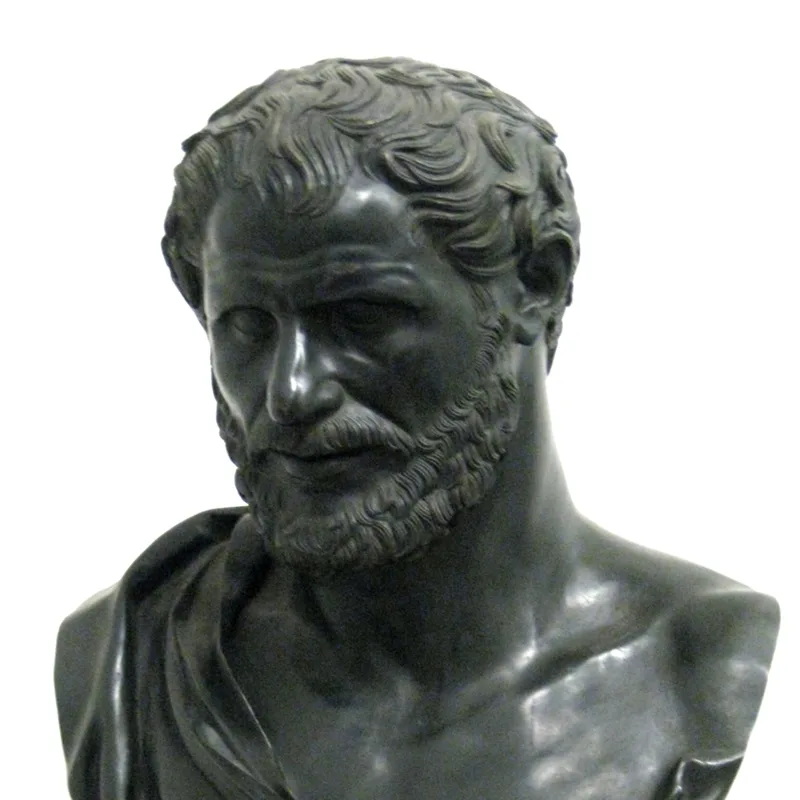
Democritus
Philosopher, c. 460 – c. 370 BC
Cheerful atomist
What is the meaning of life?
Cheerfulness: a calm, strong soul, free of fear and superstition.
Democritus of Abdera, remembered as the laughing philosopher, travelled widely and wrote some seventy works on physics, ethics, mathematics and music, of which only fragments survive. He held that the goal of life is not pleasure as such but cheerfulness, a state in which the soul stays calm and strong, untroubled by fear or superstition. In his sayings happiness is found not in bodily strength or in gold but in uprightness and understanding, and it is kept through moderation.
-
“The end of action is tranquillity, which is not identical with pleasure, as some by a false interpretation have understood, but a state in which the soul continues calm and strong, undisturbed by any fear or superstition or any other emotion.”1
-
“'Tis not in strength of body nor in gold that men find happiness, but in uprightness and in fulness of understanding.”2
What is the meaning of the universe?
Only atoms and empty space exist; everything else is opinion.
With his teacher Leucippus, Democritus developed the theory that everything is made of atoms, tiny indivisible bodies of countless shapes moving through the void, and that numberless worlds form and perish as atoms collide. Sweet, bitter, hot and cold exist only by convention; in reality there are only atoms and empty space. Later writers report that he traced belief in gods to fear of thunder, lightning and eclipses. His atomism, passed on through Epicurus and Lucretius, became the ancient world's great alternative to a designed cosmos.
-
“The first principles of the universe are atoms and empty space; everything else is merely thought to exist. The worlds are unlimited; they come into being and perish.”3