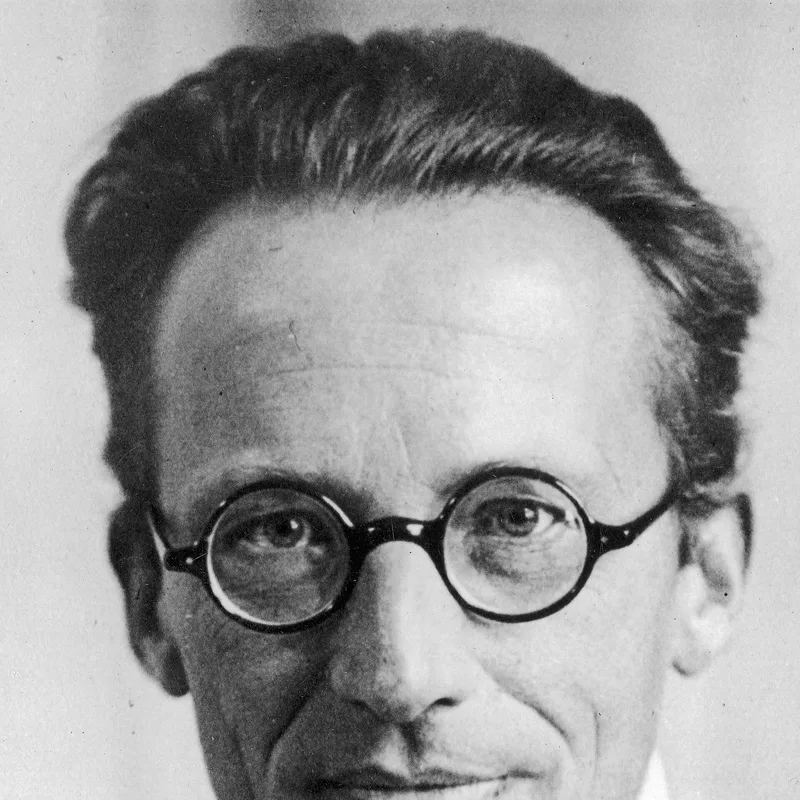
Erwin Schrödinger
Theoretical physicist, 1887–1961
Vedantist
What is the meaning of life?
Know thyself: this life of yours is, in a sense, the whole.
Schrödinger thought the question of what we are for lies outside physics. Science, he wrote in Nature and the Greeks (1954), is silent about everything that is really near to our heart and says not a word about our own ultimate scope or destination. What all knowledge is for, he said in the Dublin lectures published as Science and Humanism (1951), is to obey the Delphic command, know yourself, and to answer the demand "Who are we?" His own answer came from the Upanishads, which he had read since the First World War. In an essay written in 1925 and published in My View of the World, he argued that the life you are living is not a piece of existence but, in a certain sense, the whole — which is what the Brahmins meant by tat tvam asi, this is you.
-
“You may ask — you are bound to ask me now: What, then, is in your opinion the value of natural science? I answer: Its scope, aim and value is the same as that of any other branch of human knowledge. Nay, none of them alone, only the union of all of them, has any scope or value at all, and that is simply enough described: it is to obey the command of the Delphic deity: gnothi seauton... get to know yourself!”1
-
“It seems plain and self-evident, yet it needs to be said: the isolated knowledge obtained by a group of specialists in a narrow field has in itself no value whatsoever, but only in its synthesis with all the rest of knowledge and only inasmuch as it really contributes in this synthesis toward answering the demand, "Who are we?"”1
-
“In particular, and most importantly, this is the reason why the scientific worldview contains of itself no ethical values, no esthetical values, not a word about our own ultimate scope or destination, and no God, if you please. Whence came I and whither go I?”2
-
“This life of yours which you are living is not merely a piece of this entire existence, but in a certain sense the whole; only this whole is not so constituted that it can be surveyed in one single glance. This, as we know, is what the Brahmins express in that sacred, mystic formula which is yet really so simple and so clear; tat tvam asi, this is you. Or, again, in such words as "I am in the east and the west, I am above and below, I am this entire world."”3
What is the meaning of the universe?
One consciousness; the plurality is appearance. Atman equals Brahman.
Schrödinger took his metaphysics from Vedanta rather than from quantum mechanics, and said the two had less to do with each other than people supposed. The scientific world-picture, he argued, is built by cutting the observing subject out of it, which is why it contains no colours, no values and no God; the mind that constructs the picture is not part of it. Consciousness, he told The Observer in 1931, is absolutely fundamental and cannot be accounted for in physical terms. From there he drew the conclusion of the Upanishads, stated in the epilogue to What Is Life? (1944) and again in Mind and Matter (1958): consciousness is never experienced in the plural, the multiplicity of minds is only apparent, and in truth there is only one mind — Atman equals Brahman. He called himself an atheist, yet wrote freely in religious terms, and he held that Nature acts by no purposes and has no reverence for life.
-
“Although I think that life may be the result of an accident, I do not think that of consciousness. Consciousness cannot be accounted for in physical terms. For consciousness is absolutely fundamental. It cannot be accounted for in terms of anything else.”4
-
“The only possible alternative is simply to keep to immediate experience that consciousness is a singular of which the plural is unknown; that there is only one thing and that what seems to be a plurality is merely a series of different aspects of this one thing, produced by a deception (the Indian MAJA); the same illusion is produced in a gallery of mirrors, and in the same way Gaurisankar and Mt Everest turned out to be the same peak seen from different valleys.”5
-
“There is obviously only one alternative, namely the unification of minds or consciousnesses. Their multiplicity is only apparent, in truth there is only one mind.”6
-
“I am very astonished that the scientific picture of the real world around me is deficient. It gives a lot of factual information, puts all our experience in a magnificently consistent order, but it is ghastly silent about all and sundry that is really near to our heart, that really matters to us. It cannot tell us a word about red and blue, bitter and sweet, physical pain and physical delight; it knows nothing of beautiful and ugly, good or bad, God and eternity.”2