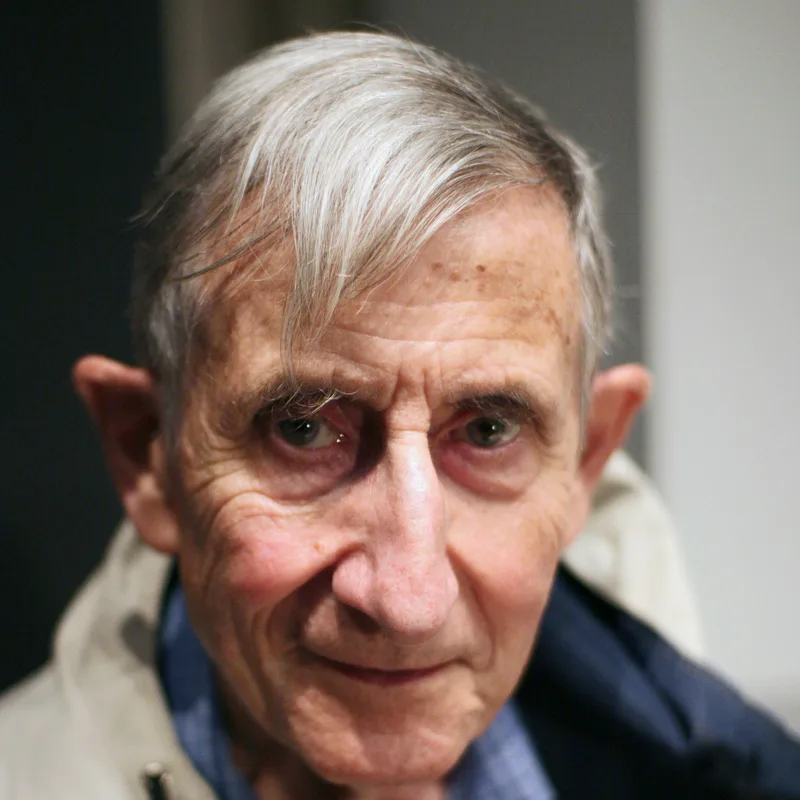
Freeman Dyson
Theoretical physicist, Mathematician, 1923–2020
Agnostic Christian
What is the meaning of life?
Good works over theology; our fate is to make the universe interesting.
Dyson gave two answers, one practical and one cosmic. The practical one came in his Templeton Prize speech in 2000: he was neither a saint nor a theologian, and good works mattered more to him than theology — sharing food more than arguing about beliefs. The cosmic one came in Infinite in All Directions (1988), his Gifford Lectures. As a working hypothesis for the riddle of our existence he proposed that ours is the most interesting of all possible universes, and that the fate of human beings is to make it so. He admitted this was a hope rather than a fact, and added that it might be our destiny to direct the future of life, if no abler creatures turn up first.
-
“As a working hypothesis to explain the riddle of our existence, I propose that our universe is the most interesting of all possible universes, and our fate as human beings is to make it so.”1
-
“I am neither a saint nor a theologian. To me, good works are more important than theology.”2
-
“Sharing the food is to me more important than arguing about beliefs. Jesus, according to the gospels, thought so too.”3
What is the meaning of the universe?
Mind woven into the universe; God is what mind becomes.
Dyson did not think the design of the universe proves God, only that it is consistent with mind playing an essential role in how it works — the universe, he wrote in Disturbing the Universe (1979), is an unexpectedly hospitable place for life. His own theology, set out in Infinite in All Directions (1988) and in his 2000 Templeton speech, saw mind at three levels: in the choices of atoms, in human consciousness and in the universe as a whole, with God as what mind becomes beyond our comprehension — a world-soul or a collection of world-souls. He called himself a practicing but not a believing Christian, treated science and religion as two windows on the same universe, and said that if the laws of nature ever turned out to be a finite set of equations he would be disappointed in the Creator's imagination.
-
“I conclude from the existence of these accidents of physics and astronomy that the universe is an unexpectedly hospitable place for living creatures to make their home in. Being a scientist, trained in the habits of thought and language of the twentieth century rather than the eighteenth, I do not claim that the architecture of the universe proves the existence of God. I claim only that the architecture of the universe is consistent with the hypothesis that mind plays an essential role in its functioning.”4
-
“I do not make any clear distinction between mind and God. God is what mind becomes when it has passed beyond the scale of our comprehension. God may be either a world-soul or a collection of world-souls. So I am thinking that atoms and humans and God may have minds that differ in degree but not in kind. We stand, in a manner of speaking, midway between the unpredictability of atoms and the unpredictability of God.”3
-
“I am a practicing Christian but not a believing Christian. To me, to worship God means to recognize that mind and intelligence are woven into the fabric of our universe in a way that altogether surpasses our comprehension.”5
-
“As we look out into the Universe and identify the many accidents of physics and astronomy that have worked together to our benefit, it almost seems as if the Universe must in some sense have known that we were coming.”6