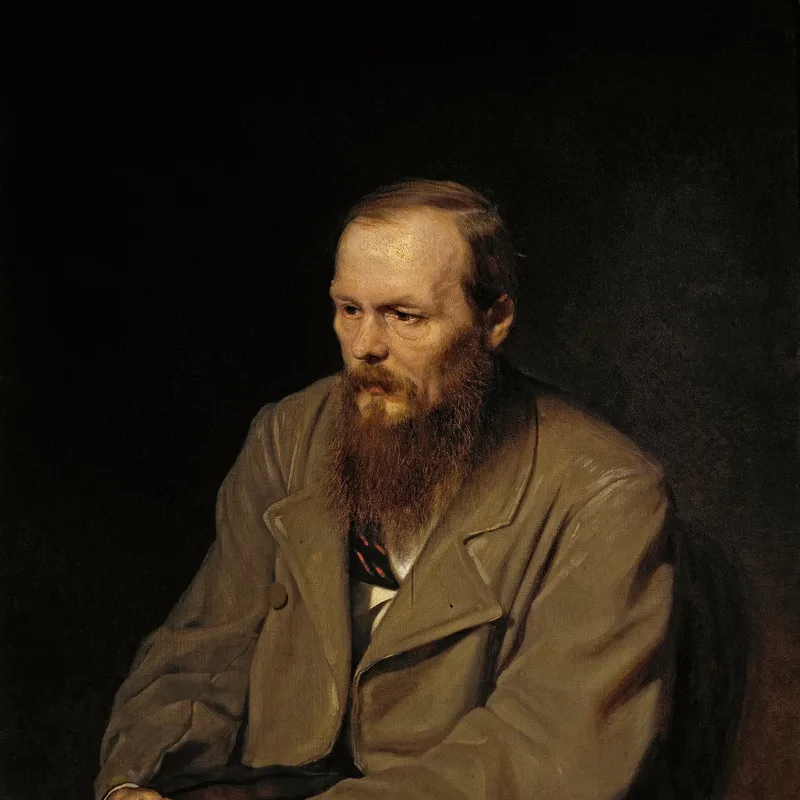
Fyodor Dostoevsky
Novelist, Journalist, 1821–1881
Russian Orthodox
What is the meaning of life?
To live by a higher idea, and to love everything.
At eighteen Dostoevsky wrote to his brother that man is a mystery and that he meant to spend his life on it. After a mock execution in 1849 and four years in a Siberian prison camp, where the only book allowed was the New Testament, his answer took a religious form. A person cannot live, he argued in A Writer's Diary (1876), without a higher idea, and the only one is the immortality of the soul; take it away and love and morality dry up. The positive answer of The Brothers Karamazov, his last novel, is given to the Elder Zosima: an active love for everything, through which the divine mystery in things becomes visible.
-
“Man is a mystery: if you spend your entire life trying to puzzle it out, then do not say that you have wasted your time. I occupy myself with this mystery, because I want to be a man.”1
-
“Neither a person nor a nation can exist without some higher idea. And there is only one higher idea on earth, and it is the idea of the immortality of the human soul, for all other "higher" ideas of life by which humans might live derive from that idea alone.”2
-
“Love all God's creation, the whole of it and every grain of sand in it. Love every leaf, every ray of God's light. Love the animals, love the plants, love everything. If you love everything, you will perceive the divine mystery in things.”3
What is the meaning of the universe?
God in Christ, believed in through a furnace of doubt.
Dostoevsky ended his life a committed Orthodox Christian, but he described his faith as something won against his own doubt. Just out of prison in 1854 he wrote to Natalya Fonvizina, who had given him a New Testament on the way to Siberia, that he was a child of unbelief and would stay one — and that he would still choose Christ over the truth if the two parted. In The Brothers Karamazov he gave the strongest case against God to Ivan: a world with the suffering of children in it cannot be accepted, and without immortality everything would be lawful. The popular line "If God does not exist, everything is permitted" is a paraphrase of that argument, not a sentence from the novel. His own notebook answer was that his hosanna had passed through the furnace of doubt.
-
“I want to say to you, about myself, that I am a child of this age, a child of unfaith and scepticism, and probably (indeed I know it) shall remain so to the end of my life. … I would even say more: If anyone could prove to me that Christ is outside the truth, and if the truth really did exclude Christ, I should prefer to stay with Christ and not with truth.”4
-
“I believe in Christ and confess him not like some child; my hosanna has passed through an enormous furnace of doubt.”5
-
“If you were to destroy in mankind the belief in immortality, not only love but every living force maintaining the life of the world would at once be dried up. Moreover, nothing then would be immoral, everything would be lawful, even cannibalism.”6