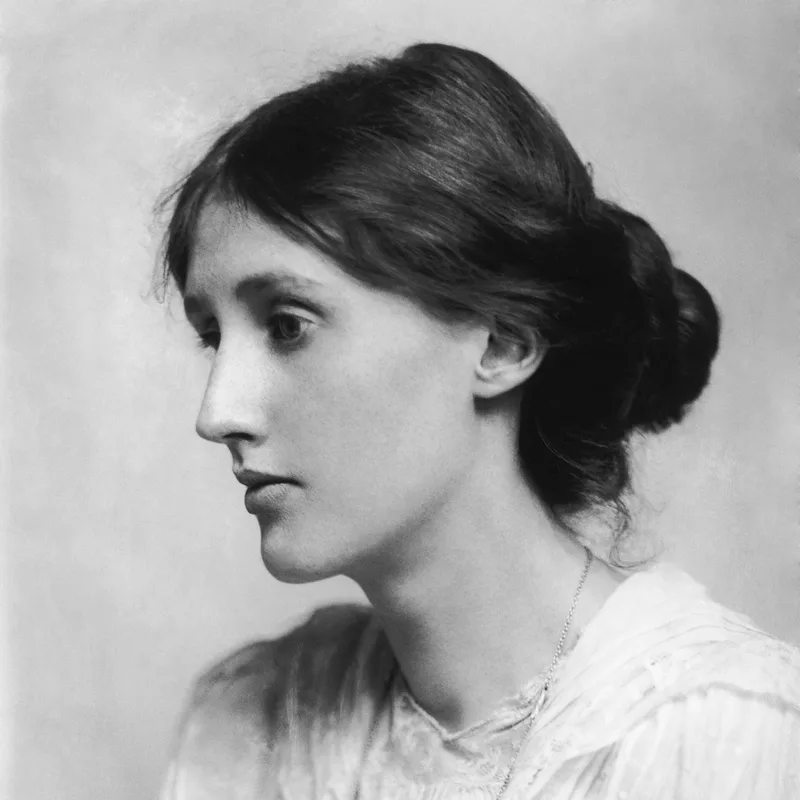
Virginia Woolf
Novelist, Essayist, Diarist, 1882–1941
Mystical atheist
What is the meaning of life?
To search for 'it', and make it real in words.
Woolf grew up without religion, and her diary shows her looking for what others found in prayer and principle. In February 1926 she wrote that she had some restless searcher in her, asking why there was no discovery in life one could lay hands on, and recorded that the night before, walking through Russell Square, she had felt 'it' in the clouds and the moon. Work held her steady: in 1929 she called herself a born melancholiac who kept afloat only by working, half believing that if she sank further she would reach the truth. In "A Sketch of the Past", written in 1939–40, she described the shocks of experience as a token of some real thing behind appearances, which she made real by putting it into words, and spoke of the rapture of discovering, in writing, what belongs to what.
-
“Great excitability and search after something. Great content – almost always enjoying what I'm at, but with constant change of mood. I don't think I'm ever bored. Yet I have some restless searcher in me. Why is there not a discovery in life? Something one can lay hands on and say 'This is it'? What is it? And shall I die before I can find it?”1
-
“Then (as I was walking through Russell Square last night) I see mountains in the sky: the great clouds, and the moon which is risen over Persia; I have a great and astonishing sense of something there, which is 'it' – A sense of my own strangeness, walking on the earth is there too.”1
-
“What a born melancholiac I am! The only way I keep afloat is by working. Directly I stop working I feel that I am sinking down, down. And as usual, I feel that if I sink further I shall reach the truth.”2
What is the meaning of the universe?
A pattern, but no God: we are the words, the music.
Woolf was born into a non-religious family: her father, Leslie Stephen, was known for writings that set out reasons to doubt religion, and her mother, Julia, wrote an essay called "Agnostic Women". In private letters she called herself an atheist, and to the composer Ethel Smyth she described religion as a kind of egotism, saying her husband Leonard had more religion in one toenail. What she had instead she called, in "A Sketch of the Past", a philosophy: behind the cotton wool of daily life there is a pattern, the whole world is a work of art and we are parts of it, but there is no maker behind it — no Shakespeare, no Beethoven, no God; we are the words, the music, the thing itself. In the essay "On Being Ill" (1926) she wrote of Nature's indifference, and of an end in which heat leaves the world and the sun goes out.
-
“That behind the cotton wool is hidden a pattern; that we – I mean all human beings – are connected with this; that the whole world is a work of art; that we are parts of the work of art. Hamlet or a Beethoven quartet is the truth about this vast mass that we call the world. But there is no Shakespeare, there is no Beethoven; certainly and emphatically there is no God; we are the words; we are the music; we are the thing itself.”3
-
“The wave of life flings itself out indefatigably. It is only the recumbent who know what, after all, Nature is at no pains to conceal—that she in the end will conquer; heat will leave the world; stiff with frost we shall cease to drag ourselves about the fields; ice will lie thick upon factory and engine; the sun will go out.”4