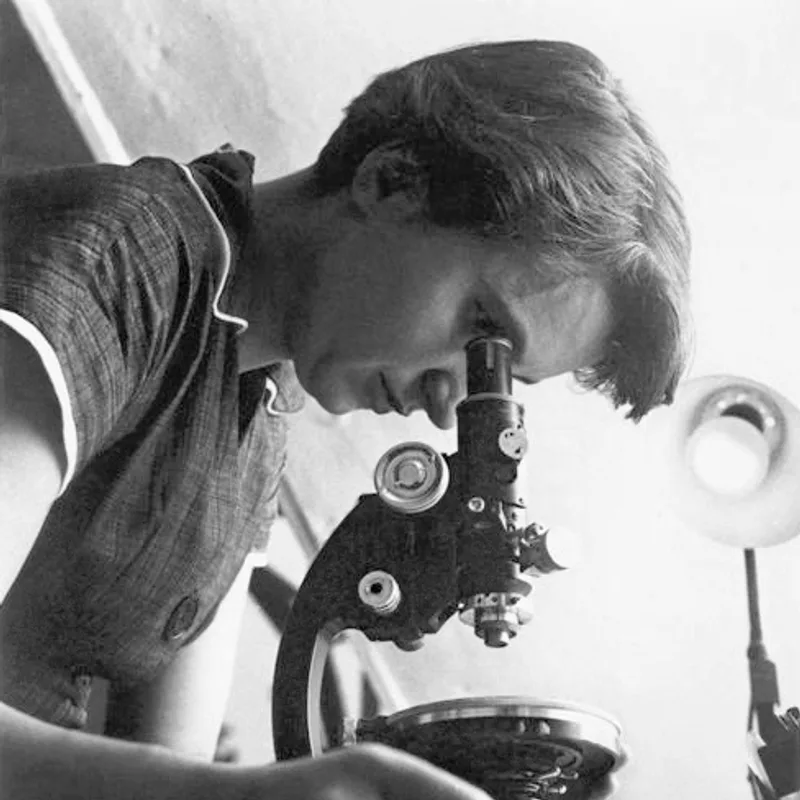
Rosalind Franklin
Chemist, X-ray crystallographer, 1920–1958
Agnostic
What is the meaning of life?
Do your best to better mankind's lot — that is faith enough.
Franklin's view of life survives in one long letter to her father, Ellis Franklin, written in the summer of 1940 when she was a Cambridge undergraduate and he had accused her of making science her religion. She refused to separate science from everyday life: science gave her a partial explanation of life, grounded in fact, experience and experiment. She agreed that faith was essential to success, but redefined it. Faith meant believing that by doing our best we come nearer to success, and that improving the lot of mankind, present and future, is worth attaining. Her father's faith rested on the future of individuals; hers on the fate of our successors, which she thought the less selfish of the two.
-
“Science and everyday life cannot and should not be separated. Science, for me, gives a partial explanation of life. In so far as it goes, it is based on fact, experience, and experiment.”1
-
“I agree that faith is essential to success in life, but I do not accept your definition of faith, i.e., belief in life after death. In my view, all that is necessary for faith is the belief that by doing our best we shall come nearer to success and that success in our aims (the improvement of the lot of mankind, present and future) is worth attaining.”1
-
“Your faith rests on the future of yourself and others as individuals, mine in the future and fate of our successors. It seems to me that yours is the more selfish.”2
What is the meaning of the universe?
If there is a creator, it has no interest in us.
Franklin was a sceptic from childhood; her mother remembered a small girl who refused to believe in God and asked how anyone knew He was not a She. In the 1940 letter to her father she took the idea of a creator apart: a creator of what? If there was a creator of protoplasm or primeval matter, she saw no reason to think it took any interest in our insignificant race in a tiny corner of the universe, still less in us as individuals — and no reason why being insignificant or accidental should weaken the kind of faith she had just defined. Beliefs about another world seemed to her to rest on nothing but their pleasantness and an exaggerated idea of our own importance. She kept her Jewish identity, telling her sister she was always consciously a Jew.
-
“I see no reason to believe that a creator of protoplasm or primeval matter, if such there be, has any reason to be interested in our insignificant race in a tiny corner of the universe, and still less in us, as still more insignificant individuals. Again, I see no reason why the belief that we are insignificant or fortuitous should lessen our faith.”2
-
“Your theories are those which you and many other people find easiest and pleasantest to believe, but so far as I can see, they have no foundation other than they lead to a pleasanter view of life (and an exaggerated idea of our own importance).”3
-
“I maintain that faith in this world is perfectly possible without faith in another world.”3