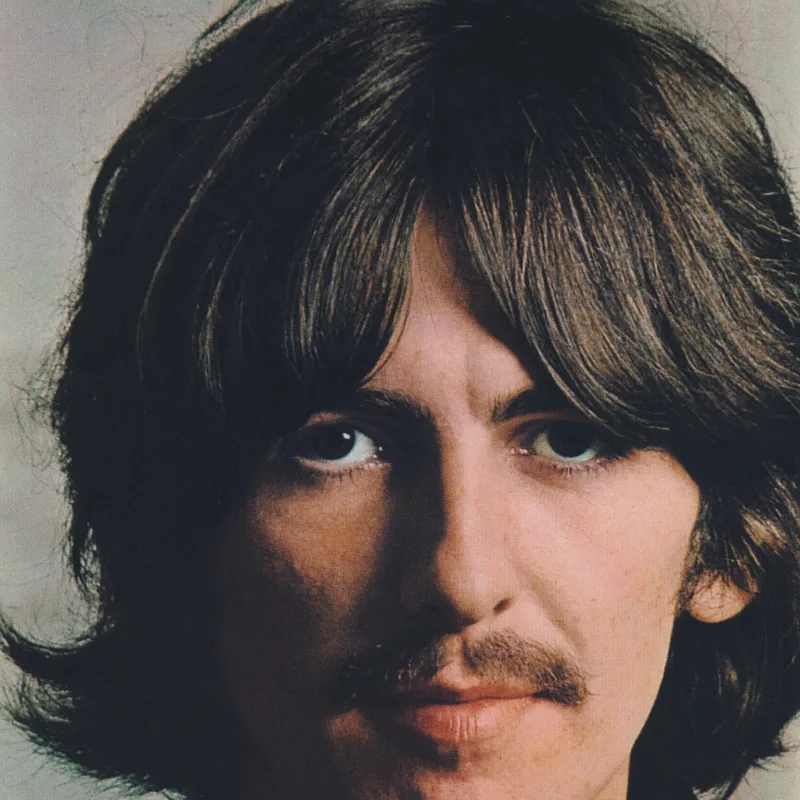
George Harrison
Singer-songwriter, Guitarist, 1943–2001
Hindu (Hare Krishna)
What is the meaning of life?
To burn out your karma and find out who you are.
Harrison's answer came from India. He first went there in 1966, studied meditation with the Maharishi in Rishikesh in 1968, and from 1969 was close to the Hare Krishna movement and its founder, Prabhupada. Asked in 1982 what the goal of human life is, he gave the Vaishnava answer: to burn out one's karma and escape maya and the cycle of rebirth, and then to pass God consciousness on to others. He liked a homelier image too — life as a string full of knots, which it is our job to untie. The starting point, he said late in life, is the desire to ask the basic questions: who am I, what am I doing here, where am I going.
-
“Each individual has to burn out his own karma and escape from the chains of maya (illusion), reincarnation, and all that. The best thing anyone can give to humanity is God consciousness. Then you can really give them something. But first you have to concentrate on your own spiritual advancement; so in a sense we have to become selfish to become selfless.”1
-
“Life is like a piece of string with a lot of knots tied in it. The knots are the karma you're born with from all your past lives, and the object of human life is to try and undo all those knots. That's what chanting and meditation in God consciousness can do.”2
-
“I think the first thing is that people have to have the desire within themselves to find out who they are. Who am I and what am I doing here and where am I going? Those sort of basic questions. Even without picking up a book or anything. If they just ask themselves that sincerely, in the quiet of the night, the door will open.”3
What is the meaning of the universe?
A personal God, Krishna, who lives in every heart.
Harrison was raised Roman Catholic in Liverpool and left the church young, but he never doubted there was a God; what he objected to was being asked to believe in a God no one could show him. Hinduism, which he found through Ravi Shankar, Yogananda and the Bhagavad Gita, promised the opposite: that God perception can be obtained by practice. In the introduction he wrote for Prabhupada's Krishna book in 1970 he put it as a demand — if there's a God, I want to see Him — and called the religions branches of one tree. He worshipped God in personal form, as Krishna, and believed in the soul and in reincarnation. The same God, he said, lives in every heart, which is why the search turns inward first.
-
“If there's a God, I want to see Him. It's pointless to believe in something without proof, and Krishna consciousness and meditation are methods where you can actually obtain God perception. In that way you can see, hear and play with God. Perhaps this may sound weird, but God is really there next to you.”4
-
“From the Hindu perspective, each soul is divine. All religions are branches of one big tree. It doesn't matter what you call Him just as long as you call.”5
-
“Through the Indian philosophy and all that I came into contact with, it just showed me that it's actually inside. He lives in our hearts. It's a matter of turning your consciousness inward in order to then realize that it's in there, and then you can see him outside too. It's just a shift in attitude, really.”3