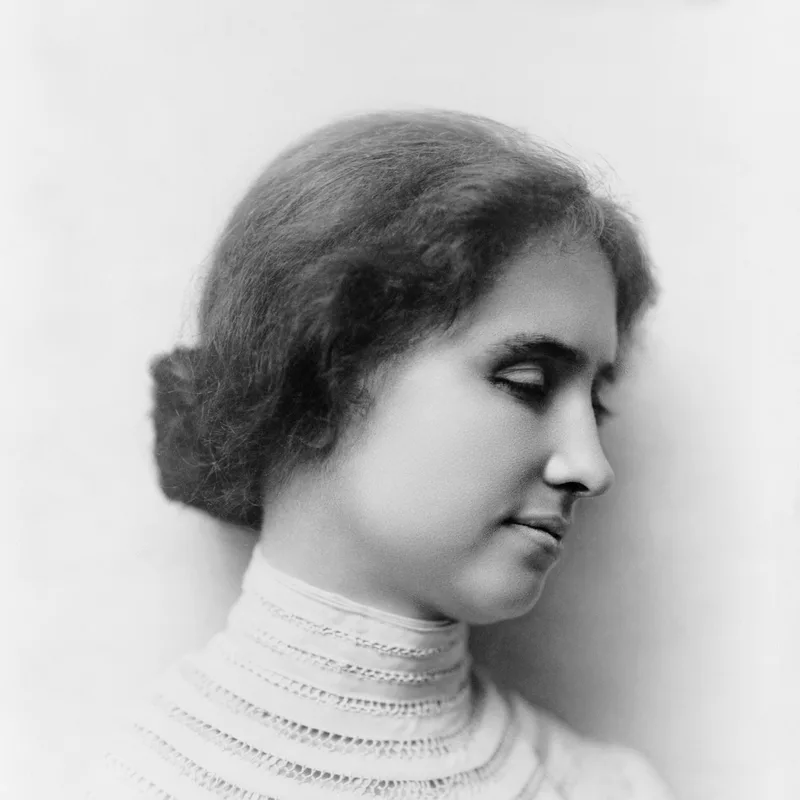
Helen Keller
Author, Disability rights advocate, 1880–1968
Swedenborgian
What is the meaning of life?
Life, not wealth: love, joyful labour, and easing another's pain.
Keller lost her sight and hearing to an illness at nineteen months and communicated only through home signs until Anne Sullivan came to teach her in 1887. In Optimism, an essay published in 1903 while she was at Radcliffe College, she wrote that by the usual measures of happiness she had every reason to weep, yet she was happy, and that her chief duty and joy was to do humble tasks as though they were great and noble. In We Bereaved (1929), written for the grieving people who wrote to her, she said that so long as one can sweeten another's pain, life is not in vain. In Midstream, the sequel to her autobiography published the same year, she wrote that life, not wealth, is the aim of existence: life with its love, happiness and joyful labour.
-
“I long to accomplish a great and noble task; but it is my chief duty and joy to accomplish humble tasks as though they were great and noble. It is my service to think how I can best fulfil the demands that each day makes upon me, and to rejoice that others can do what I cannot.”1
-
“Believe, when you are most unhappy, that there is something for you to do in the world. So long as you can sweeten another's pain, life is not in vain.”2
-
“I believe that life, not wealth, is the aim of existence — life including all its attributes of love, happiness, and joyful labour.”3
What is the meaning of the universe?
A God who is near, two worlds, and death as life eternal.
Keller came to religion by asking who made the world. Told as a small child that Mother Nature had, she later learned from the clergyman Phillips Brooks what she called the central truth that God is Love. At about seventeen she began reading the eighteenth-century Swedish mystic Emanuel Swedenborg, and in 1956 she said she had tried to live by his teachings ever since; My Religion (1927) is her account of them. Her God was near rather than remote — in Optimism she placed him in earth, sea and sky and in every noble impulse of the heart — and she held that there are two worlds, the one we measure and the one we feel. Death, she wrote, is not the end of life but one of its most important experiences, and she could not understand why anyone should fear it.
-
“Deep, solemn optimism, it seems to me, should spring from this firm belief in the presence of God in the individual; not a remote, unapproachable governor of the universe, but a God who is very near every one of us, who is present not only in earth, sea and sky, but also in every pure and noble impulse of our hearts, “the source and centre of all minds, their only point of rest.””1
-
“But I know there are two worlds — one we can measure with line and rule, and the other we can feel with our hearts and intuitions. Swedenborg makes the future life not only conceivable, but desirable.”4
-
“I cannot understand why anyone should fear death. Life here is more cruel than death — life divides and estranges, while death, which at heart is life eternal, reunites and reconciles.”4