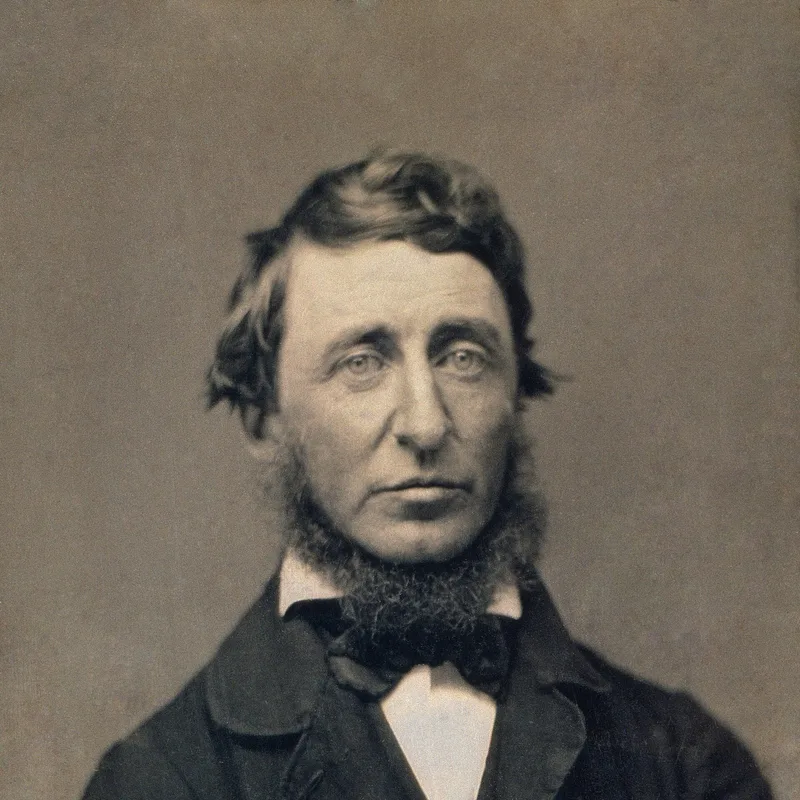
Henry David Thoreau
Essayist, Naturalist, 1817–1862
Transcendentalist
What is the meaning of life?
To live deliberately, close to the essential facts of life.
Thoreau, a member of Emerson's Transcendentalist circle in Concord, Massachusetts, thought most people live by habit and borrowed opinion — lives of quiet desperation, as Walden puts it. In 1845 he built a cabin at Walden Pond and lived there for two years and two months, to find out how little a person needs and what is left when the rest is stripped away. Walden (1854) is the report. His answer is to live on purpose: to simplify, to pay attention, and to make each day, even in its details, worth the scrutiny of one's best hour. Those who follow their own direction with confidence, he concluded, find the world's laws loosening around them.
-
“I went to the woods because I wished to live deliberately, to front only the essential facts of life, and see if I could not learn what it had to teach, and not, when I came to die, discover that I had not lived.”1
-
“Every man is tasked to make his life, even in its details, worthy of the contemplation of his most elevated and critical hour.”1
-
“I learned this, at least, by my experiment; that if one advances confidently in the direction of his dreams, and endeavors to live the life which he has imagined, he will meet with a success unexpected in common hours.”2
What is the meaning of the universe?
God is now and here; we are partly earth ourselves.
Thoreau was raised a Unitarian and left the church; like Emerson he looked for the divine in nature and in the individual mind rather than in scripture or creed, and he read the Hindu scriptures at Walden alongside the Bible. In Walden he insists that what people place far away — truth, eternity, God — is present now and here, and that he himself is part of the earth he watched. Climbing Mount Katahdin in Maine in 1846 he met nature as raw, indifferent matter, and found that the deepest mystery was not spirit but the plain fact of contact with rock, wind and earth.
-
“Men esteem truth remote, in the outskirts of the system, behind the farthest star, before Adam and after the last man. In eternity there is indeed something true and sublime. But all these times and places and occasions are now and here. God himself culminates in the present moment, and will never be more divine in the lapse of all the ages.”1
-
“Shall I not have intelligence with the earth? Am I not partly leaves and vegetable mould myself?”3
-
“Talk of mysteries! — Think of our life in nature, — daily to be shown matter, to come in contact with it, — rocks, trees, wind on our cheeks! The solid earth! the actual world! the common sense! Contact! Contact! Who are we? where are we?”4