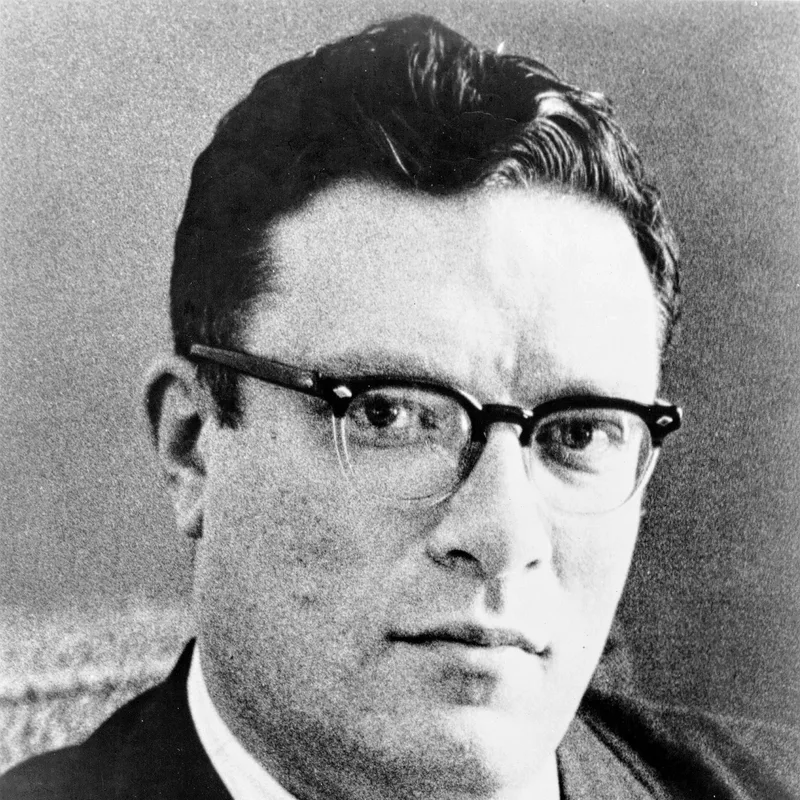
Isaac Asimov
Science fiction writer, Biochemist, 1920–1992
Atheist humanist
What is the meaning of life?
To learn all you can of the universe, and enjoy it.
Asimov's answer was to use the one life there is: learn as much of the universe as possible and enjoy doing it. He told Bill Moyers in 1988, by which time he had written 391 books, that his own drive was sheer hedonism, and that it would be a tragedy to pass through life and get nothing out of it. Decency, in his view, needed no heaven or hell; people behave well because it makes them feel better and makes the world better. As honorary president of the American Humanist Association from 1985 until his death, he gave the shared version: humanity will survive only by its own efforts, because miracles don't happen.
-
“It seems to me that when it's time to die, and that will come to all of us, there'll be a certain pleasure in thinking that you had utilized your life well, that you had learned as much as you could, gathered in as much as possible of the universe, and enjoyed it. I mean, there's only this one universe and only this one lifetime to try to grasp it. … I mean, what a tragedy just to pass through and get nothing out of it.”1
-
“It seems to me that it's insulting to human beings to imply that only a system of rewards and punishments can keep you a decent human being. Isn't it conceivable a person wants to be a decent human being because that way he feels better? Because that way the world is better?”2
-
“As indicated by our very name, we humanists celebrate humanity, want humanity to survive, and recognize that if humanity does survive, it will be by its own efforts. Never can we sit back and wait for miracles to save us. Miracles don't happen. Sweat happens. Effort happens. Thought happens.”3
What is the meaning of the universe?
No God, nothing supernatural; death is a dreamless sleep.
Asimov wrote that he had never for one moment been tempted toward religion. By the time he read the Bible, science fiction and science books had already given him their picture of the universe, and he took Genesis and the miracles for Hebrew myths, like the Greek and Norse myths he knew. For years he avoided the word atheist because it seemed to claim knowledge he did not have, and called himself a humanist or an agnostic; in a 1982 interview with Free Inquiry he said outright that he was an atheist. He believed that death is followed by nothingness, an eternal and dreamless sleep. On the cosmos he speculated, with Moyers, about universes rising like bubbles out of a limitless vacuum, ours just happening to suit life.
-
“I am an atheist, out and out. It took me a long time to say it. … I finally decided that I'm a creature of emotion as well as of reason. Emotionally, I am an atheist. I don't have the evidence to prove that God doesn't exist, but I so strongly suspect he doesn't that I don't want to waste my time.”4
-
“I have never, in all my life, not for one moment, been tempted toward religion of any kind. The fact is that I feel no spiritual void. I have my philosophy of life, which does not include any aspect of the supernatural and which I find totally satisfying. I am, in short, a rationalist and believe only that which reason tells me is so.”5
-
“I am firm in my beliefs. I am an atheist and, in my opinion, death is followed by an eternal and dreamless sleep.”6
-
“And if the universe doesn't expand forever, if it goes into a crunch and disappears, there may be a limitless, a really limitless ocean of vacuum out of which new universes are constantly arising like bubbles in boiling water; some large, some small, some with one set of laws, some with another. We just happen to be living in one that's suitable for life.”1