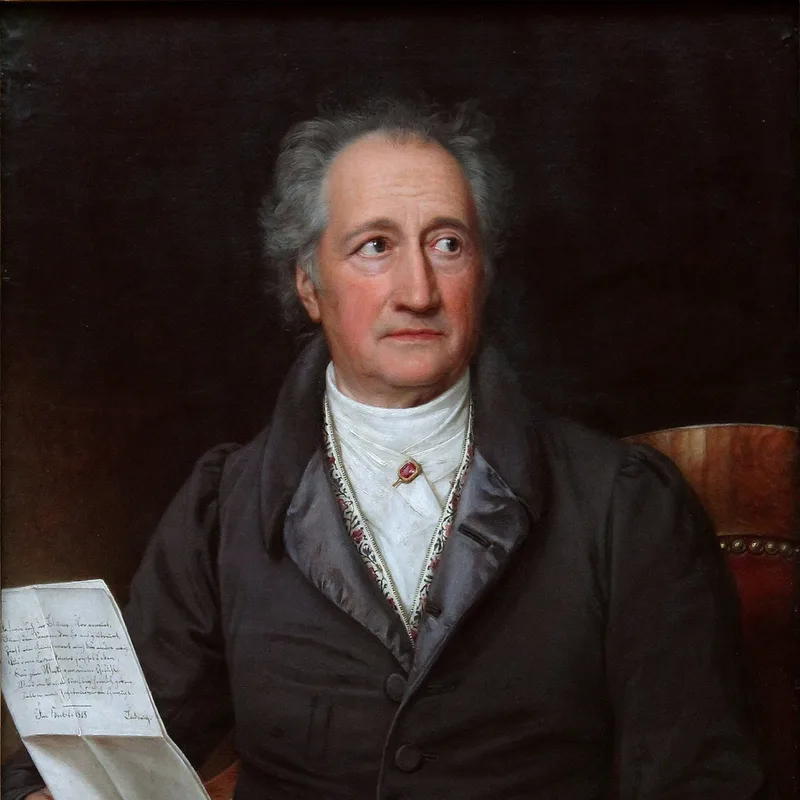
Johann Wolfgang von Goethe
Poet, Playwright, Natural scientist, 1749–1832
Pantheist
What is the meaning of life?
To act: meet the day's demands, and make the transitory permanent.
Goethe's answer was activity. A person comes to know himself not by thinking but by doing, and his duty is simply what the day demands; the maxim appeared in Wilhelm Meister's Journeyman Years (1829) and was later gathered with his other maxims. He had no patience with brooding over the transience of things: we are here, he wrote, to make the transitory permanent. His hope of surviving death rested on the same idea. Talking with his secretary Johann Peter Eckermann in 1829, at seventy-nine, he said that if he worked ceaselessly until the end, nature would be bound to give him another form of existence.
-
“How can a man come to know himself? Never by thinking, but by doing. Try to do your duty, and you will know at once what you are worth. But what is your duty? The claims of the day.”1
-
“I pity those who make much ado about the transitory nature of all things and are lost in the contemplation of earthly vanity: are we not here to make the transitory permanent? This we can do only if we know how to value both.”2
-
“To me, the eternal existence of my soul is proved from my idea of activity; if I work on incessantly till my death, nature is bound to give me another form of existence when the present one can no longer sustain my spirit.”3
What is the meaning of the universe?
God at work in living, changing nature, manifest in the sun.
Goethe was a freethinker who held that one could be inwardly Christian without following any church, and he looked for God in nature rather than in doctrine. In 1829 he told Eckermann that the divine works in what is living and becoming, not in what is dead and fixed, and shows itself in the primal phenomena of nature, behind which one should not try to look. On 11 March 1832, eleven days before his death, he said he revered Christ as the divine manifestation of the highest principle of morality, and the sun as a manifestation of the highest Being, in which he adored the light and the productive power of God. He also set a limit on the question: people are not born to solve the problems of the universe, only to find out where they begin.
-
“If I am asked whether it is in my nature to revere the Sun, I again say—certainly! For he is likewise a manifestation of the highest Being, and indeed the most powerful which we children of earth are allowed to behold. I adore in him the light and the productive power of God; by which we all live, move, and have our being—we, and all the plants and animals with us.”4
-
“The divinity works in the living not in the dead; in the becoming and changing, not in the become and the fixed.”5
-
“Man is born not to solve the problems of the universe, but to find out where the problem begins, and then to restrain himself within the limits of the comprehensible. His faculties are not sufficient to measure the actions of the universe; and an attempt to explain the outer world by reason is, with his narrow point of view, but a vain endeavor. The reason of man and the reason of the Deity are two very different things.”6