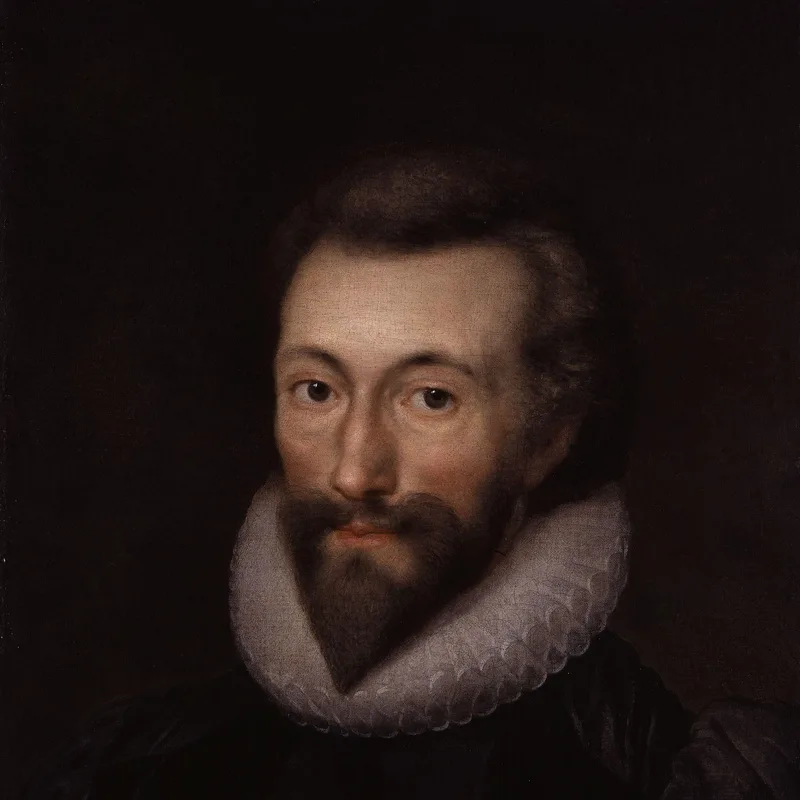
John Donne
Poet, Cleric, 1572–1631
Anglican
What is the meaning of life?
No man is an island; every death diminishes me.
Donne was born a Catholic in Protestant England, wrote witty and sensual love poems as a young man, and became a priest of the Church of England and Dean of St Paul's Cathedral in London. In 1623 he fell gravely ill, and while recovering he wrote Devotions upon Emergent Occasions, a series of meditations on each stage of his sickness. In the seventeenth, hearing a church bell toll for a funeral, he reflects that no one is separate from the rest of humanity. Any person's death is a loss to everyone, because all of us are bound up in mankind.
-
“No man is an island, entire of itself; every man is a piece of the continent, a part of the main. If a clod be washed away by the sea, Europe is the less, as well as if a promontory were, as well as if a manor of thy friend's or of thine own were: any man's death diminishes me, because I am involved in mankind…”1
What is the meaning of the universe?
God is the author; death translates each life into a better language.
For Donne, humanity is one book written by one author. A death does not tear a chapter out of it; God translates that chapter into a better language, and will one day bind all the scattered leaves together in a library where every book lies open to every other. In his Holy Sonnets he turns the same faith against death itself, which he tells not to be proud: after one short sleep we wake eternally, and death shall be no more.
-
“…all mankind is of one author, and is one volume; when one man dies, one chapter is not torn out of the book, but translated into a better language; and every chapter must be so translated; God employs several translators; some pieces are translated by age, some by sickness, some by war, some by justice; but God's hand is in every translation, and his hand shall bind up all our scattered leaves again for that library where every book shall lie open to one another.”1