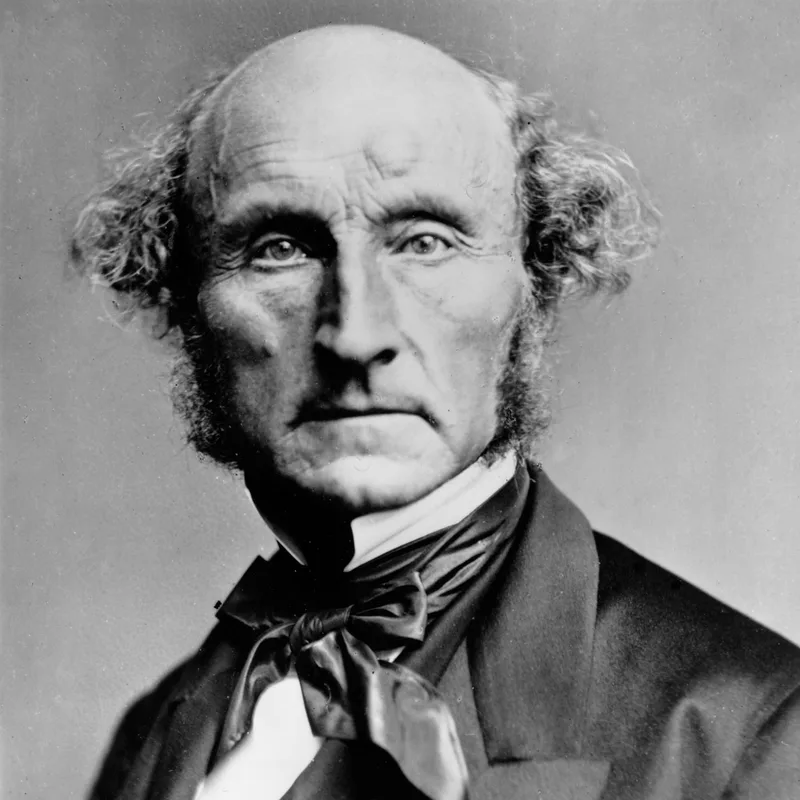
John Stuart Mill
Philosopher, Economist, Member of Parliament, 1806–1873
Agnostic
What is the meaning of life?
Aim beyond your own happiness; happiness comes on the way.
Mill was educated by his father as a prodigy, Greek at three and Latin at eight, and trained to work for the general happiness, the goal of utilitarianism. At twenty he fell into a depression in which he saw that even the success of all his aims would not make him happy. He came out of it, partly through Wordsworth's poetry, with a lesson he kept for life: happiness is not found by aiming at it directly, but by fixing the mind on something else, such as the good of others or a pursuit followed for its own sake.
-
“Those only are happy (I thought) who have their minds fixed on some object other than their own happiness; on the happiness of others, on the improvement of mankind, even on some art or pursuit, followed not as a means, but as itself an ideal end. Aiming thus at something else, they find happiness by the way.”1
-
“Ask yourself whether you are happy, and you cease to be so.”1
What is the meaning of the universe?
Neither belief nor atheism: on the supernatural, honest scepticism.
Mill was brought up without any religion by his father, who could not reconcile a world full of evil with a creator who was both good and all-powerful. In his essay on theism, published after his death, he weighed the argument from design and found that it gave some probability to a creator, but to one of limited power, since an all-powerful God would need no contrivances. His verdict on the supernatural was neither belief nor denial but suspended judgment. Hope, he allowed, was legitimate, as long as it remained hope and not belief.
-
“I am thus one of the very few examples, in this country, of one who has not thrown off religious belief, but never had it: I grew up in a negative state with regard to it.”2
-
“…the rational attitude of a thinking mind towards the supernatural, whether in natural or in revealed religion, is that of scepticism as distinguished from belief on the one hand, and from atheism on the other…”3