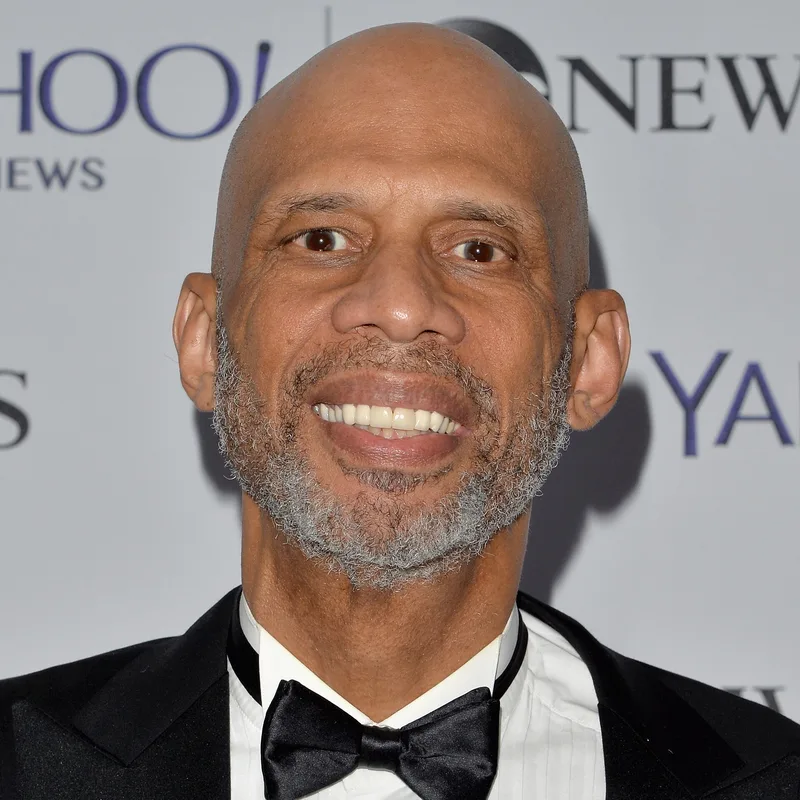
Kareem Abdul-Jabbar
Basketball player, Writer, born 1947
Sunni Muslim
What is the meaning of life?
Real joy is family and friends; success is helping others succeed.
Abdul-Jabbar's answers about life point outward, to family, friends and other people. Asked by AARP in 2015, some years after a leukemia diagnosis, what his blueprint for getting older was, he named the pursuit of goals and dreams and connecting with family and friends, which he called the real joy in life. In a 2019 Hollywood Reporter column he took up the Joker's claim that civilized morality is a thin veneer over an indifferent universe, and answered that even if the universe is indifferent, most people are not. Addressing Washington University's graduates in 2021, he said he could not call himself a success if he wasn't helping others have a chance at success, and described a successful life as one spent demanding justice, fair play and equality for all people.
-
“The continued pursuit of goals and dreams and, realistically, connecting with family and friends. That is where the real joy in life is.”1
-
“Yet, even if the universe is indifferent, most people are not. We share each other’s grief and try to lighten each other’s burdens caused by that “one bad day.””2
-
“I hope your story will include a few pages in which you went out into the world and demanded justice, demanded fair play, demanded equality for all people. Now, that’s a successful life.”3
What is the meaning of the universe?
Islam, chosen by faith and logic, as a moral anchor.
Abdul-Jabbar was raised Catholic and left the church when he went to UCLA. Reading The Autobiography of Malcolm X as a freshman led him to study the Quran, and in 1971, at 24, he took the name Kareem Abdul-Jabbar, "the noble one, servant of the Almighty". In a 2015 essay he wrote that the more he studied history, the more disillusioned he became with Christianity's role in subjugating his people, and that he was embracing a religion that was part of his African heritage. After breaking with his first teacher, Hamaas Abdul Khaalis, he went to Libya and Saudi Arabia in 1973 to learn enough Arabic to read the Quran himself, and came back with his faith renewed. A convert's belief, he wrote, rests on faith and logic together; what he wanted from his faith, he told NPR, was a moral anchor.
-
“This decision set me on an irreversible course to spiritual fulfillment. But it definitely wasn’t a smooth course. I made serious mistakes along the way. Then again, maybe the path isn’t supposed to be smooth; maybe it’s supposed to be filled with obstacles and detours and false discoveries in order to challenge and hone one’s beliefs.”4
-
“For the person who converts, it is a matter of fierce conviction and defiance. Our belief is based on a combination of faith and logic because we need a powerful reason to abandon the traditions of our families and community to embrace beliefs foreign to both.”5
-
“The whole idea for me was to have a moral anchor, and it served as a very excellent one for me. I don't have any misgiving about my faith.”6