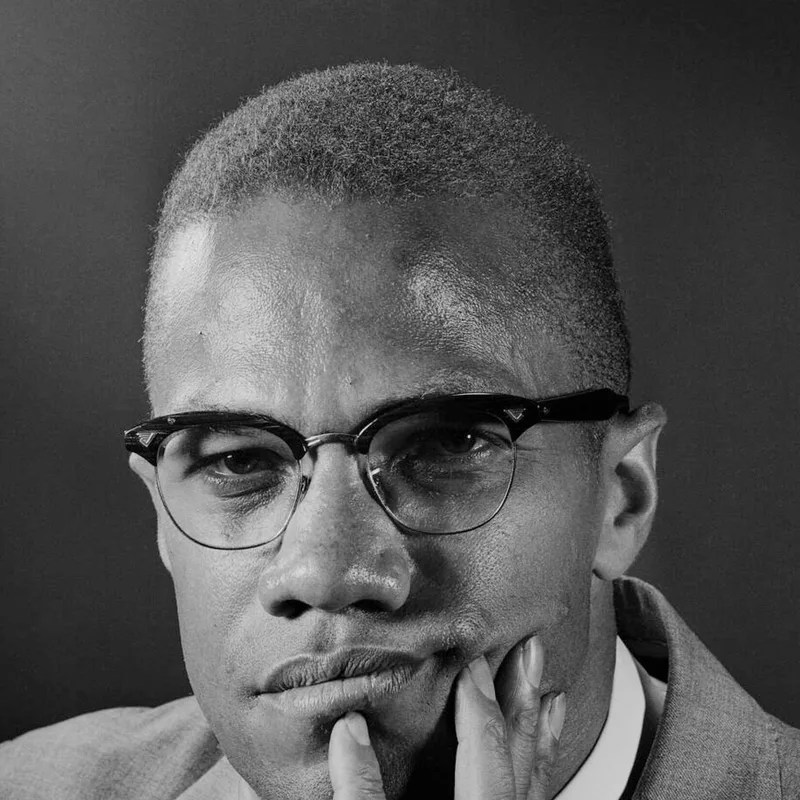
Malcolm X
Muslim minister, Human rights activist, 1925–1965
Sunni Muslim
What is the meaning of life?
To stand for truth and justice, for humanity as a whole.
What Malcolm X said he lived for was truth and justice, and he said it most clearly in his last year. In prison in the late 1940s he turned from crime to reading and to the Nation of Islam, and from 1952 he was its spokesman, preaching black self-reliance and separation from whites. He broke with the Nation in March 1964, and on the Hajj that April he wrote that, despite his firm convictions, he had always tried to face facts and to accept the reality of life as new experience and new knowledge unfolded it. In the autobiography he wrote with Alex Haley, published months after his assassination in February 1965, he called himself a human being first and foremost, for whoever and whatever benefits humanity as a whole.
-
“I'm for truth, no matter who tells it. I'm for justice, no matter who it's for or against. I'm a human being first and foremost, and as such I am for whoever and whatever benefits humanity as a whole.”1
-
“Despite my firm convictions, I have always been a man who tries to face facts, and to accept the reality of life as new experience and new knowledge unfolds it.”2
What is the meaning of the universe?
One God, Allah, whose oneness implies the oneness of man.
By his own account Malcolm Little was an atheist in prison when one of his brothers told him about Islam; he began to read in that direction and joined the Nation of Islam. As its minister he taught its doctrines, including that its founder, Wallace Fard Muhammad, was God incarnate and Elijah Muhammad his Messenger. After leaving the Nation in 1964 he became a Sunni Muslim, and on the Hajj, praying beside Muslims of every color, he wrote that belief in one God had removed the "white" from the minds of white Muslims, and that white Americans who accepted the Oneness of God might accept the Oneness of Man. He held his faith to be personal, between himself and the God in whom he believed, and in his 1964 speeches he asked audiences to keep religion at home so that they could work together.
-
“Yes, well, I was in prison and I was an atheist. I didn’t believe in anything, and I had begun to read books and things.”3
-
“I could see from this, that perhaps if white Americans could accept the Oneness of God, then perhaps, too, they could accept in reality the Oneness of Man — and cease to measure, and hinder, and harm others in terms of their "differences" in color.”2
-
“Islam is my religion, but I believe my religion is my personal business. It governs my personal life, my personal morals. And my religious philosophy is personal between me and the God in whom I believe; just as the religious philosophy of these others is between them and the God in whom they believe.”4