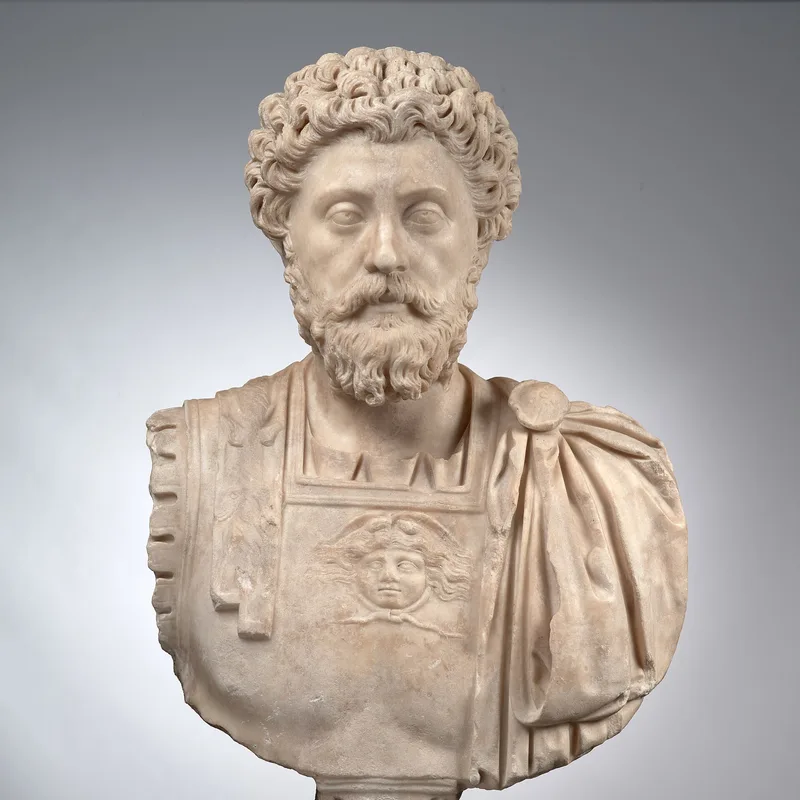
Marcus Aurelius
Roman emperor, Stoic philosopher, 121–180
Stoic
What is the meaning of life?
To do the work of a human being: act justly, love mankind.
Marcus Aurelius wrote the Meditations in Greek, for himself, in army camps on the Danube in the 170s; it was never meant to be read by anyone else. The answer he keeps returning to is the Stoic one. A human being is a rational and social animal, made for cooperation like the hands or the eyelids, so the work of a life is to act justly toward others and to accept whatever happens as part of the whole. Only virtue is good; health, wealth, fame and length of life are indifferent, and death is a natural dissolution. Many lines that circulate under his name, such as "You have power over your mind, not outside events", are modern paraphrases and are not in the book.
-
“In the morning when thou risest unwillingly, let this thought be present,—I am rising to the work of a human being. Why then am I dissatisfied if I am going to do the things for which I exist and for which I was brought into the world? Or have I been made for this, to lie in the bed-clothes and keep myself warm?”1
-
“What then is that which is able to conduct a man? One thing, and only one, philosophy. But this consists in keeping the daemon within a man free from violence and unharmed, superior to pains and pleasures, doing nothing without a purpose, nor yet falsely and with hypocrisy … accepting all that happens, and all that is allotted, as coming from thence, wherever it is, from whence he himself came; and, finally, waiting for death with a cheerful mind.”2
-
“We are made for co-operation, like feet, like hands, like eyelids, like the rows of the upper and lower teeth. To act against one another then is contrary to nature; and it is acting against one another to be vexed and to turn away.”3
-
“Do not act as if thou wert going to live ten thousand years. Death hangs over thee. While thou livest, while it is in thy power, be good.”4
What is the meaning of the universe?
One living whole ruled by providence, or atoms; act well either way.
As a Stoic, Marcus saw the universe as a single living being with one substance and one soul, run through by reason and governed by providence; the gods exist and care about human affairs. All things are woven together, every event is spun out from the whole from the beginning, and the same forms come round again in endless cycles. He knew the rival Epicurean picture, atoms meeting by chance in the void, and nine times in the Meditations he set the two side by side as "providence or atoms". His point was that the right way to live is the same on either account: if there is an order, trust it; if there is only confusion, you still carry a ruling intelligence in yourself. Death, likewise, is either dispersion or change, and no evil in either case.
-
“Constantly regard the universe as one living being, having one substance and one soul; and observe how all things have reference to one perception, the perception of this one living being; and how all things act with one movement; and how all things are the co-operating causes of all things which exist; observe too the continuous spinning of the thread and the contexture of the web.”5
-
“Everything harmonizes with me, which is harmonious to thee, O Universe. Nothing for me is too early nor too late, which is in due time for thee. Everything is fruit to me which thy seasons bring, O Nature: from thee are all things, in thee are all things, to thee all things return.”6
-
“The universe is either a confusion, and a mutual involution of things, and a dispersion, or it is unity and order and providence. If then it is the former, why do I desire to tarry in a fortuitous combination of things and such a disorder? … But if the other supposition is true, I venerate, and I am firm, and I trust in him who governs.”7
-
“But to go away from among men, if there are gods, is not a thing to be afraid of, for the gods will not involve thee in evil; but if indeed they do not exist, or if they have no concern about human affairs, what is it to me to live in a universe devoid of gods or devoid of providence? But in truth they do exist, and they do care for human things, and they have put all the means in man's power to enable him not to fall into real evils.”8