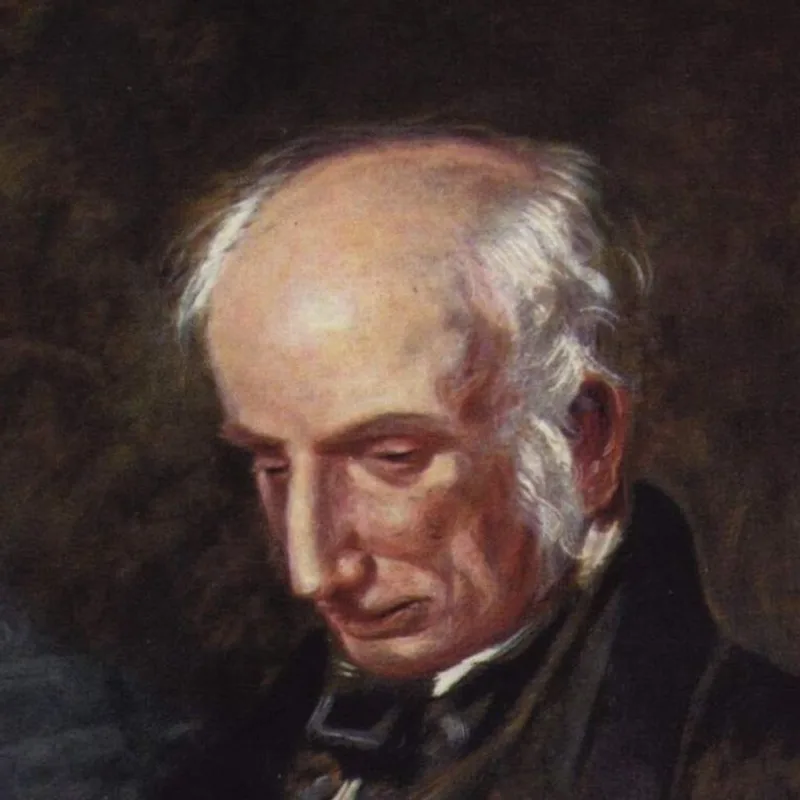
William Wordsworth
Poet, 1770–1850
Nature pantheist, later Anglican
What is the meaning of life?
The best of life: little, nameless, unremembered acts of kindness.
Wordsworth grew up in the English Lake District, lost both parents as a boy, and in 1798 published Lyrical Ballads with Samuel Taylor Coleridge, the book usually taken to mark the start of English Romanticism. He believed that nature teaches what books cannot, and that a single spring day in the woods could teach more about good and evil than all the sages. In “Tintern Abbey” he credits his memories of the landscape with shaping the best part of a good man's life: his small, forgotten acts of kindness and love. He became Poet Laureate in 1843.
-
“…feelings too / Of unremembered pleasure; such, perhaps, / As may have had no trivial influence / On that best portion of a good man’s life; / His little, nameless, unremembered acts / Of kindness and of love.”1
-
“One impulse from a vernal wood / May teach you more of man; / Of moral evil and of good, / Than all the sages can.”2
What is the meaning of the universe?
A spirit rolls through all things, in nature and in mind.
In “Tintern Abbey” Wordsworth described feeling a presence in the light of setting suns, the ocean, the air and the human mind: a motion and a spirit that runs through every thinking thing and every object of thought. Readers have long seen pantheism in these lines, a God not above nature but moving within it. Later in life Wordsworth became a conventional member of the Church of England and revised some of his early poetry in a more orthodox direction. Yet the young poet's sense of one life flowing through everything is what he is best remembered for.
-
“And I have felt / A presence that disturbs me with the joy / Of elevated thoughts; a sense sublime / Of something far more deeply interfused, / Whose dwelling is the light of setting suns, / And the round ocean, and the living air, / And the blue sky, and in the mind of man, / A motion and a spirit, that impels / All thinking things, all objects of all thought, / And rolls through all things.”1