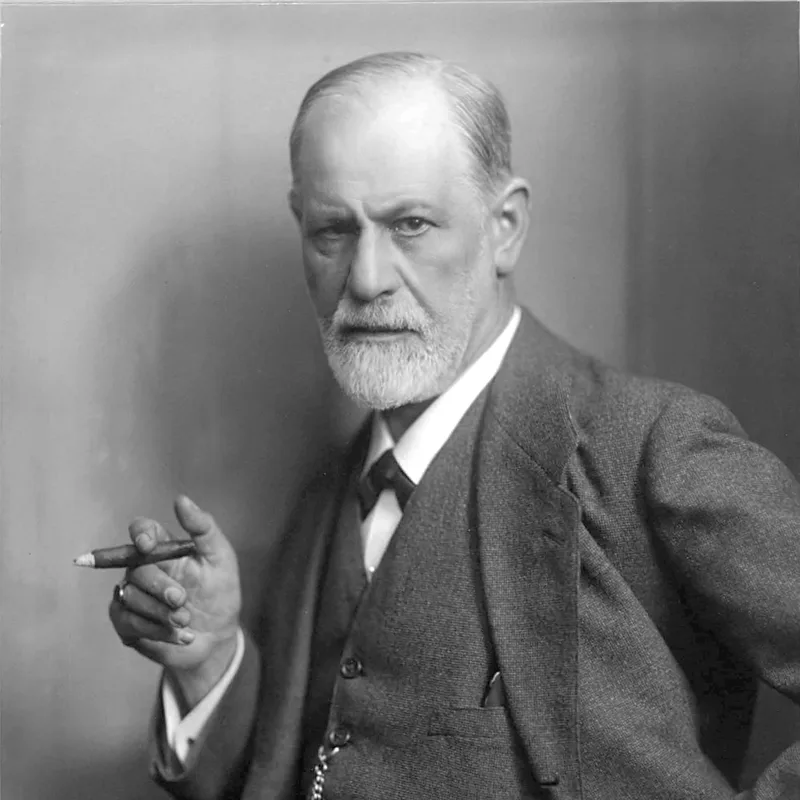
Sigmund Freud
Neurologist, Founder of psychoanalysis, 1856–1939
Atheist
What is the meaning of life?
No purpose without religion; people seek happiness, which the world resists.
In Civilization and Its Discontents (1930) Freud wrote that the question of the purpose of human life has never received a satisfactory answer and perhaps admits of none, and that the very idea of a purpose in life stands or falls with religion. He turned instead to what people show by their behaviour that they want: happiness, meaning on one side the absence of pain and on the other the experience of strong pleasure. That, he said, is simply the programme of the pleasure principle. It cannot be carried out, because suffering comes from three sides at once: our own bodies, which decay; the outer world, which is pitiless; and our relations with other people, which he thought the most painful of all.
-
“The question, 'What is the purpose of human life?' has been asked times without number; it has never received a satisfactory answer; perhaps it does not admit of such an answer. … So again, only religion is able to answer the question of the purpose of life. One can hardly go wrong in concluding that the idea of a purpose in life stands and falls with the religious system.”1
-
“We will turn, therefore, to the less ambitious problem, what the behaviour of men themselves reveals as the purpose and object of their lives, what they demand of life and wish to attain in it. The answer to this can hardly be in doubt: they seek happiness, they want to become happy and to remain so.”1
-
“As we see, it is simply the pleasure-principle which draws up the programme of life's purpose. … It simply cannot be put into execution, the whole constitution of things runs counter to it; one might say the intention that man should be 'happy' is not included in the scheme of 'Creation'.”1
What is the meaning of the universe?
No God behind it; religion is wishful illusion, science our guide.
Freud was an atheist; when he married in 1886 he was dismayed that Austrian law required a Jewish religious ceremony. In The Future of an Illusion (1927) he treated religion as a product of human need rather than a report about the universe. Helpless before nature, fate and death, people give the forces around them the features of a father and make them into gods, and religious doctrines are illusions: fulfilments of the oldest, strongest and most insistent wishes of mankind, whose strength is the strength of those wishes. Against them he set science, and he closed the book by insisting that science is no illusion, and that it would be one to expect from anywhere else what science cannot give.
-
“But men's helplessness remains, and with it their father-longing and the gods. The gods retain their threefold task: they must exorcise the terrors of nature, they must reconcile one to the cruelty of fate, particularly as shown in death, and they must make amends for the sufferings and privations that the communal life of culture has imposed on man.”2
-
“It will be found if we fix our attention on the psychical origin of religious ideas. These, which profess to be dogmas, are not the residue of experience or the final result of reflection; they are illusions, fulfilments of the oldest, strongest and most insistent wishes of mankind; the secret of their strength is the strength of these wishes.”3
-
“No, science is no illusion. But it would be an illusion to suppose that we could get anywhere else what it cannot give us.”4