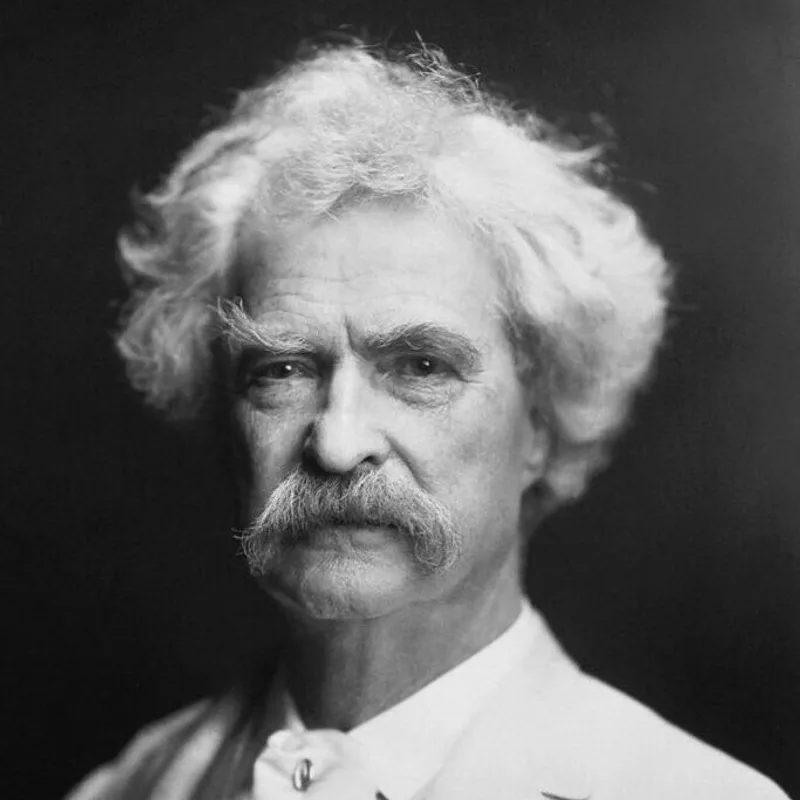
Mark Twain
Novelist, Humorist, Essayist, 1835–1910
Skeptical deist
What is the meaning of life?
Everyone seeks self-approval; train your ideals until that helps others.
Twain's fullest answer is What Is Man?, a dialogue between an old man and a young one that he called his gospel and his Bible. He wrote it in Vienna in 1898, kept it back because his wife Olivia could not bear it, and printed it anonymously in 1906. In it a person is a machine shaped by temperament and training, and every act, noble or base, has one first object: the person's own peace of mind, which he called the hunger for self-approval. What is left to do is to train that hunger upward, until one's chief pleasure lies in conduct that also benefits one's neighbour and the community. Writing to William Dean Howells at the time, he said that the book had cost him his respect and his pride in the human race.
-
“From his cradle to his grave a man never does a single thing which has any FIRST AND FOREMOST object but one—to secure peace of mind, spiritual comfort, for HIMSELF.”1
-
“Diligently train your ideals upward and still upward toward a summit where you will find your chiefest pleasure in conduct which, while contenting you, will be sure to confer benefits upon your neighbor and the community.”2
-
“I suspect that to you there is still dignity in human life, & that man is not a joke—a poor joke—the poorest that was ever contrived. Since I wrote my Bible … man is not to me the respect-worthy person he was before, & so I have lost my pride in him & can't write gaily nor praisefully about him any more.”3
What is the meaning of the universe?
An almighty God who governs by fixed law and sends no messages.
Twain was a Presbyterian by background and grew more critical of organised religion as he aged, keeping his sharpest views out of print. In private statements from the early 1880s he set down a creed: he believed in God the Almighty, but not that God had ever sent a message to anyone, nor in the Bible as revelation, nor in special providences; the universe runs on strict and immutable laws. Later his God grew larger and more remote, a Creator beside whom the gods of human imagination were a swarm of gnats, and in darker moods less benevolent. On death he said that annihilation held no terrors for him, since he had already tried it for a hundred million years before he was born; yet around 1908, as his biographer Albert Bigelow Paine recorded, he said he had never seen an atom of proof of a future life and was still strongly inclined to expect one.
-
“I believe in God the Almighty. I do not believe He has ever sent a message to man by anybody, or delivered one to him by word of mouth, or made Himself visible to mortal eyes at any time in any place.”4
-
“I do not believe in special providences. I believe that the universe is governed by strict and immutable laws: If one man's family is swept away by a pestilence and another man's spared it is only the law working: God is not interfering in that small matter, either against the one man or in favor of the other.”4
-
“Let us now consider the real God, the genuine God, the great God, the sublime and supreme God, the authentic Creator of the real universe … by comparison with whom the gods whose myriads infest the feeble imaginations of men are as a swarm of gnats scattered and lost in the infinitudes of the empty sky.”5
-
“Annihilation has no terrors for me, because I have already tried it before I was born—a hundred million years—and I have suffered more in an hour, in this life, than I remember to have suffered in the whole hundred million years put together.”6