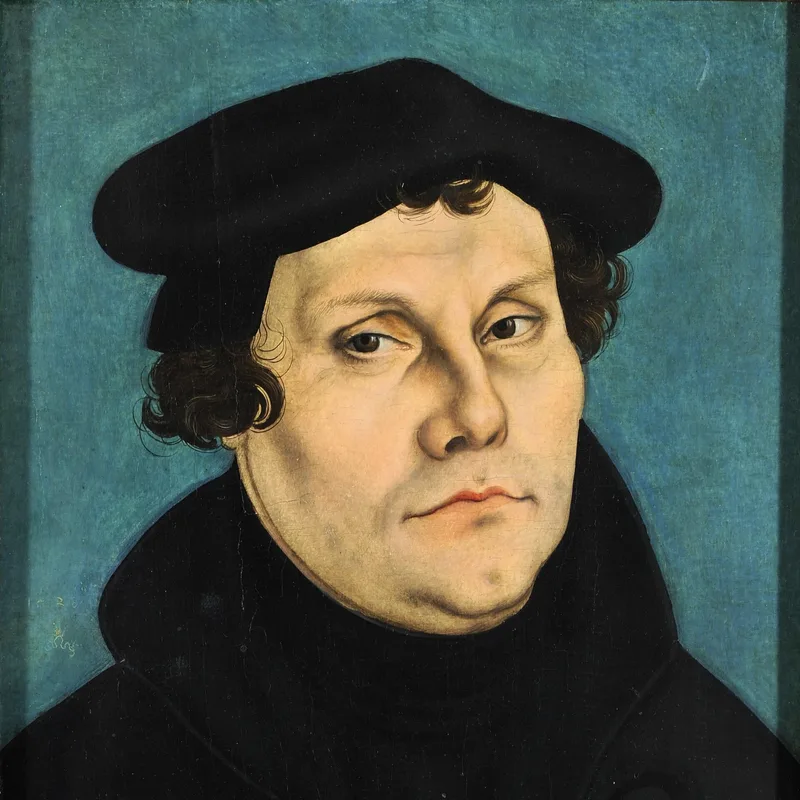
Martin Luther
Theologian, Reformer, 1483–1546
Protestant reformer
What is the meaning of life?
Freed by faith, a Christian becomes everyone's willing servant.
Luther was an Augustinian monk and professor in Wittenberg whose Ninety-five Theses against the sale of indulgences in 1517 set off the Protestant Reformation. He came to believe that people are saved by God's grace, received through faith, and not by their own good works. In his 1520 treatise on Christian liberty he drew the consequence for daily life: faith makes a Christian free, lord of all and subject to none, and that same freedom makes him the servant of all, doing good to others because he no longer has anything to earn.
-
“A Christian man is the most free lord of all, and subject to none; a Christian man is the most dutiful servant of all, and subject to every one.”1
What is the meaning of the universe?
God is the one from whom we expect all good.
Luther's God is the creator who gives everything freely and the hidden God whose ways cannot be fathomed, made known only in Christ. In his Large Catechism (1529) he explained the First Commandment by asking what it means to have a god at all. A god is whatever we look to for every good and run to in every trouble; to have a God is to trust him with the whole heart. Whatever your heart clings to and relies on, he wrote, is really your god.
-
“What does it mean to have a god? or, what is God? Answer: A god means that from which we are to expect all good and to which we are to take refuge in all distress, so that to have a God is nothing else than to trust and believe Him from the [whole] heart…”2