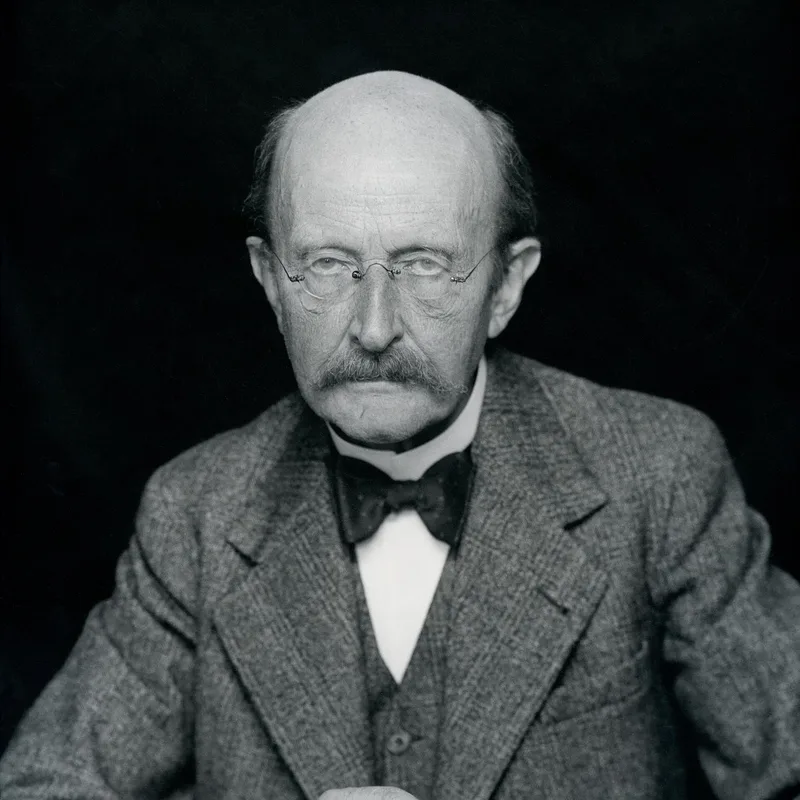
Max Planck
Theoretical physicist, 1858–1947
Deist
What is the meaning of life?
Seek truth tirelessly; find peace of mind in a link to God.
Planck's answer has two parts, science and religion, and he gave them different jobs. Science, he wrote in Where Is Science Going? (1932), aims at a goal it can never fully reach, the thing in itself, and what enriches the seeker is not the possession of truth but the success of seeking it. But knowledge does not tell us how to act. In his 1937 lecture Religion and Natural Science, given while the Nazi state pressed on both church and university, he said natural science wants man to learn while religion wants him to act, and that only a direct inner link to God gives the inner firmness and lasting peace of mind he called the highest boon in life. Ethics, he added, lies entirely outside the realm of natural science.
-
“It is not the possession of truth, but the success which attends the seeking after it, that enriches the seeker and brings happiness to him.”1
-
“But science sets out confidently on the endeavor finally to know the thing in itself, and even though we realize that this ideal goal can never be completely reached, still we struggle on towards it untiringly. And we know that at every step of the way each effort will be richly rewarded.”1
-
“Natural science wants man to learn, religion wants him to act.”2
-
“Long and tedious reflection cannot enable us to shape our decisions and attitudes properly; only that definite and clear instruction which we gain can form a direct inner link to God. This instruction alone is able to give us the inner firmness and lasting peace of mind which must be regarded as the highest boon in life.”2
What is the meaning of the universe?
Consciousness is fundamental; behind the atom, an intelligent mind.
Planck held that physics presupposes a real outer world independent of us, lawful through and through, and he broke with Ernst Mach's positivism over it. Yet in 1931 he told The Observer that he regarded consciousness as fundamental and matter as derived from it: we cannot get behind consciousness. God stood for him at the end of that order rather than inside it — the foundation for the believer and the crown of the edifice for the physicist, as he put it in Religion and Natural Science (1937) — and behind the force that holds atoms together he assumed a conscious and intelligent mind. A Lutheran church elder, he nonetheless said late in life that he did not believe in a personal God, let alone a Christian one, and he expected belief in miracles to vanish before science. Science itself, he wrote, cannot solve the ultimate mystery of nature, because we are part of nature and so part of the mystery.
-
“I regard consciousness as fundamental. I regard matter as derivative from consciousness. We cannot get behind consciousness. Everything that we talk about, everything that we regard as existing, postulates consciousness.”3
-
“Both religion and science require a belief in God. For believers, God is in the beginning, and for physicists He is at the end of all considerations… To the former He is the foundation, to the latter, the crown of the edifice of every generalized world view.”4
-
“There is no matter as such! All matter originates and exists only by virtue of a force which brings the particles of an atom to vibration and holds this most minute solar system of the atom together. . . . We must assume behind this force the existence of a conscious and intelligent Mind. This Mind is the matrix of all matter.”5
-
“Science cannot solve the ultimate mystery of nature. And that is because, in the last analysis, we ourselves are part of nature and therefore part of the mystery that we are trying to solve.”6