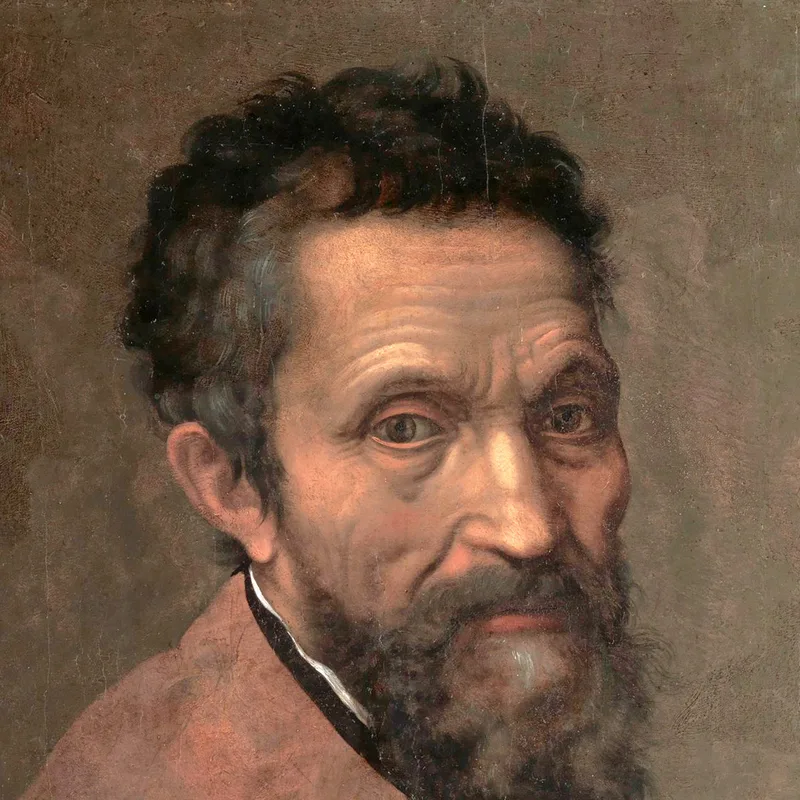
Michelangelo
Sculptor, Painter, Poet, 1475–1564
Catholic, Neoplatonist
What is the meaning of life?
Not art, his idol, but a life lived well, turned toward God.
Michelangelo left no treatise; his answer is in letters and poems, most of them written in old age. For most of his life art was what he lived for, and in a sonnet sent to Giorgio Vasari in September 1554, at seventy-nine, he judged that passion vain: the fond fancy that had made art the idol and monarch of his soul was full of error, now that his life had reached the port where all must give account. In another sonnet of those years he wrote that the fables of the world had taken the time he should have given to God. Writing to Vasari in April 1554 about the lavish christening of his great-nephew, while war raged around Siena, he said that such joy ought to be kept for the death of one who has lived well.
-
“Now hath my life across a stormy sea / Like a frail bark reached that wide port where all / Are bidden, ere the final reckoning fall / Of good and evil for eternity. / Now know I well how that fond phantasy / Which made my soul the worshipper and thrall / Of earthly art, is vain; how criminal / Is that which all men seek unwillingly.”1
-
“The fables of the world have filched away / The time I had for thinking upon God; / His grace lies buried 'neath oblivion's sod, / Whence springs an evil crop of sins alway.”2
-
“But I must say that I am displeased with so much pomp and show. Man ought not to laugh when the whole world weeps. So I think that Lionardo has not displayed great judgment, particularly in celebrating a nativity with all that joy and gladness which ought to be reserved for the decease of one who has lived well.”3
What is the meaning of the universe?
God, mirrored in beauty, whose love opened its arms on the cross.
Michelangelo was a devout Catholic whose faith deepened at the end of his life, in part through his friendship with the poet Vittoria Colonna, with whom he exchanged sonnets on spiritual questions. As a youth he had lived among the Platonist humanists of the Medici circle, and his love sonnets speak their language: beauty comes from heaven, and God shows himself nowhere more clearly than in a beautiful human form, which he loves because God is mirrored in it. In old age the emphasis turned to the cross and the final reckoning: neither painting nor sculpture could quiet a soul turned to the divine love that opened its arms on the cross. After his servant Urbino died in December 1555, he wrote to Vasari in February 1556 that the grace given him was that Urbino's death had taught him to die not with displeasure but with desire, and that his only hope was to see him again in Paradise.
-
“Painting nor sculpture now can lull to rest / My soul that turns to His great love on high, / Whose arms to clasp us on the cross were spread.”1
-
“Nor hath God deigned to show Himself elsewhere / More clearly than in human forms sublime; / Which, since they image Him, alone I love.”4
-
“You know that Urbino is dead. I owe the greatest thanks to God, at the same time that my own loss is heavy and my sorrow infinite. The grace He gave me is that, while Urbino kept me alive in life, his death taught me to die without displeasure, rather with a deep and real desire.”5